
Episode Summary:
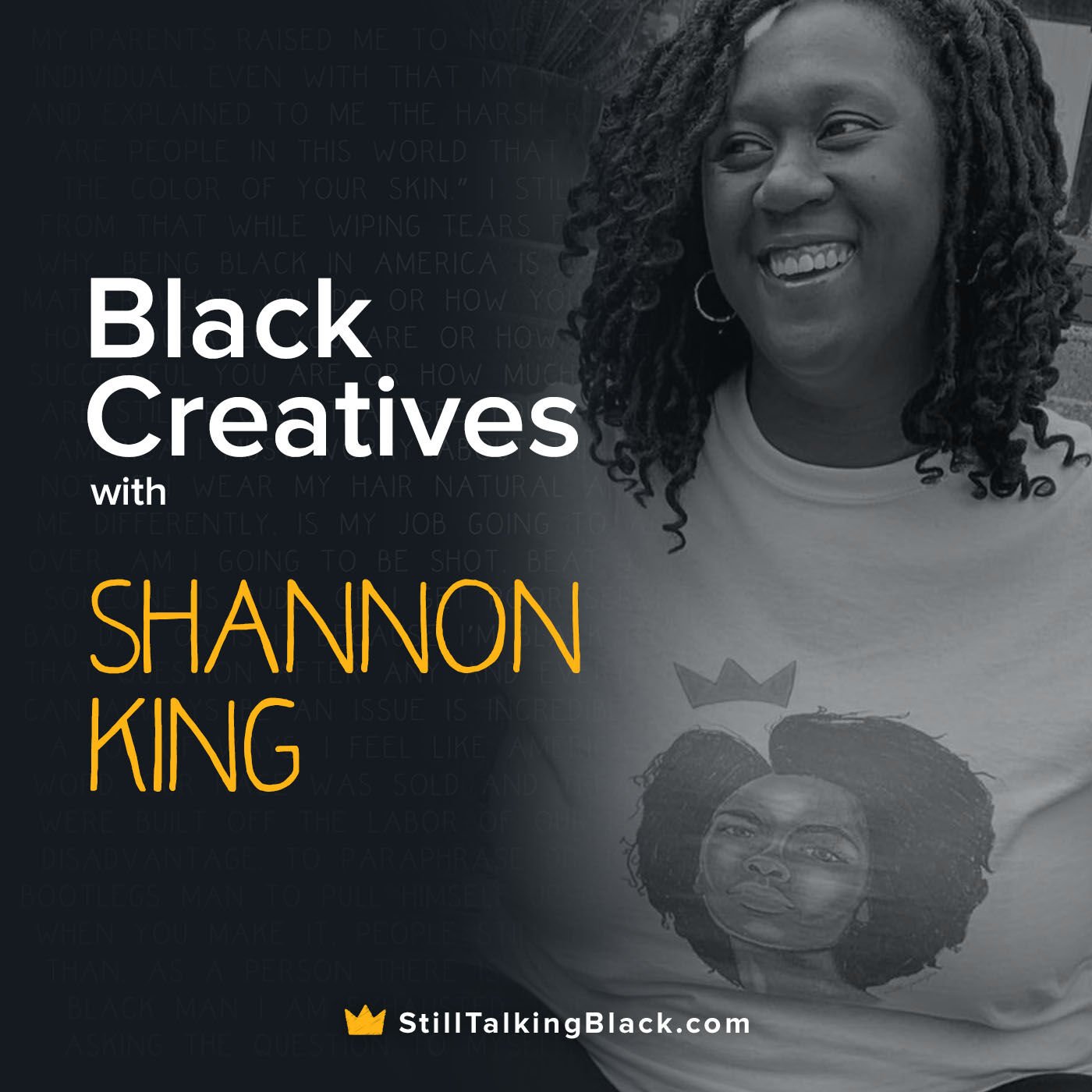
This episode is all about Black creatives. Richard discusses how hip-hop mimics negro spirituals, and how Black people use their art as an expression of their pain and protest. Later in the episode, he talks to Shannon King of The Not Your Enemy Brand: Speak Out Sessions about what it means to be a Black Creative.
Show your Support:
If you like what we are doing here the best way to show your support is by rating, sharing, and subscribing/following our podcast. Another way to show your support is by giving us a donation at BuyMeACoffee.com/CrownedCulture. We appreciate any and all support.
About the Interviewee:
Shannon King is a multi-talented creator and podcaster. Shannon, alongside her podcast partner Jared L. White hosts The Not Your Enemy Brand: Speak Out Sessions, where they talk to other creators about issues facing the Black community. You can follow Shannon on Instagram @visionaryccb. You can find the podcast: not-your-enemy-speak-out-sessions.castos.com and the episode featuring Richard here: not-your-enemy-speak-out-sessions.castos.com/episodes/speak-out-sessions-wrichard
Spotlight on Melanin:
This episode’s spotlight is on Creative Bre. Creative Bre is a very talented graphic designer, illustrator, and painter that has a variety of products ranging from stickers to prints, to t-shirts. You can find her on Instagram @CreativeBre, and you can find links to her shop here: CreativeBre.com/Shop
Credits:
Host and Producer: Richard Dodds @Doddsism
Show Music: @IAmTheDjBlue
Episode Transcript
Richard Dodds 0:00
Coming up later in the episode,
Shannon King 0:02
black creative it means everything.
Shannon King 0:04
You are the originator, the cultivator of so many things that people will still want to be part of. And I think that being a black creator requires strength and fortitude, but also like you are an original, like I think there’s a lot of people that don’t even think of themselves as creatives or creators. We do create a lot of things, we create a lot of things that we don’t get credit for. That’s what I would say. It’s everything like being a black creator is everything.
Richard Dodds 0:33
This is still talking black, a show about giving perspectives to issues that minorities face every day. I’m your host, Richard Dodds. Today’s episode is all about black creative. Later in the episode, I talked to a fellow creator and podcaster Shannon king of not your enemy, speak out sessions about what it means to be a black creator.
Richard Dodds 0:55
From music, to theater, to art, so much of ourselves, our ups, downs, our joy, and our pain go into our craft, from transcendent artists like Nina Simone who used her music as a way of helping to spread her message of black empowerment to Maya Angelou, who used her poetic words to instill so forth. I feel like more than any other people, black people put so much of ourselves and the things that we do. Our art has always been a way of telling our stories. It goes all the way back to the Negro spirituals was told stories of their past stories of hope, stories of loss and history, and many times the spirituals held double meanings. spirituals were away for slaves to express themselves. Sometimes stories of hope, were really messages of how to escape. You can hear the influences of spirituals and many other genres of music, from blues to gospel, and even hip hop. I feel like more than any other genre of music, hip hop and rap have carry on the filling of the artful protest and storytelling. Songs like Jay Z story of oj nws f the police and Public Enemies fight the poWER are all great examples of protest through rhythmic words. And so Phil beats the level of artistry we’ll have you nodding your head before you fully grasp the true meaning of their words. There are many artists that are still carrying the torch of protest music today. Artists like Toby in week ways song I need you to that calls for justice for Brianna Taylor, one of my favorite is Joyner Lucas’s I’m not racist. I must admit when I first saw the music video for this song, I was taking a little bit of back. The song has two men sitting across from each other at a table. One black and one Caucasian. joiner is not in the video at all. Instead, it’s two actors, starting with the Caucasian man wearing magga hat given his perspective on black people from his point of view, I’m not racist after lions that could be taken as offensive. The second verse turns the tables to the black man who responds to the things that he’s just heard. By the end of the video, they hug as they both try to understand each other better. I think the thing that really makes this so powerful is the way that it cleverly shows how not understanding someone’s perspective can skew the way that you view an individual or group of individuals. A lot of misconceptions are born from a lack of understanding. And I believe this is a lesson that we all need to learn moving from rap to so Joseph Angel’s American funeral talks about the unfair treatment and views of minorities in America. from there to the rock band Algiers, whose front man and lyricist Franklin James Fisher says, quote, a reoccurring theme in our music is the idea of injustice and the bitter understanding that obtaining justice in this world is all but impossible, particularly for black and brown people, in quote, are their 2017 release Cleveland, they gave the description of their song on their Instagram. Quote, it is about the institutional murder of black people and lamentation for those who’ve lost their lives within this context and an indictment of those responsible and quote, there are many more examples in music, but let’s move to television, and 2019 Netflix released the miniseries when they see us directed and co written by Ava DuVernay, when they see us is based off the true story of the Central Park five, which involve five minorities accused and convicted of a vicious attack in Central Park on April 19 1989. It showed the pain of seeing young minorities be charged and convicted of crimes that they didn’t commit and later shows the same of the treatment they received after being fully exonerated. This was one of those things that was hard to watch, but it’s definitely necessary if you’re also that same year in 2019. The movie Just Mercy starring Michael B. Jordan and Jamie Foxx was released. It was a completely different story, but it had very similar things. Just Mercy is a biographical movie based on Bryan Stevenson, a Harvard Law graduate that went to Alabama to fight for me on death row that cannot afford proper legal representation. There are many movies, songs, poems, and other expressions of art. But these are songs that stick out on my mind. Some of our art is meant to evoke the feelings that the artists was feeling or felt some of it as a not so silent protest that oppressions that we faced and still face. Some of us simply tell stories that should never be forgotten stories that everyone should know. There are so many different ways that we use our art. We are known for being soulful, and I wonder how much of that soul comes from the pain that our ancestors have faced and the injustice is that we still face today.
Richard Dodds 5:41
If you like what we’re doing here, I’m still talking black, the best way to show your support is by liking, rating and sharing our content. Another way to help is by making a donation using the link in the episode description. We are currently looking for advertising partners. If you’re interested in the possibility of advertising on our show, please send all inquiries to advertise, I still talk in black Comm. Who is Shannon King,
Shannon King 6:06
I’m still figuring that out. To be quite honest, I would love to call myself a creative, I feel like my mind has always been in that creative space in Rome. But I think I’ve just now solidify where I’m at, like, Who am I, where am I and who I am. And what I’m capable of. So for me, unapologetically black. That’s a given. Always at this point, especially in today’s environment, and culture. And I just like to create, I like to create and collaborate, that is something that brings me joy that I’m passionate about. And however that looks and whatever landscape I’m in, that is what I enjoy and love to do. So I’m still figuring out, but that’s where I’m at. That’s my foundation,
Richard Dodds 6:48
you do podcasts.
Shannon King 6:50
I mean, I wouldn’t list a lot of things, okay. Because, again, my mind and creativity and your creative lens can be across a lot of boards, right podcast, we also have a payroll and things of that nature that are attributed to the podcast, I have a mom blog that is dormant right now because I got levels to this, but a mom blog that is going to come back soon, I’m just trying to get the content and also be a mom at the same time. I work full time. I am like a marketing assistant. So I do all social media marketing for a local nonprofit. And I do consultant work where I do social media work for other businesses. And then I’m also a real estate agent. That in there, yep, threw that in there. Do that. And therefore,
Richard Dodds 7:41
a lot of stuff. Yeah,
Shannon King 7:43
yeah. Yeah.
Richard Dodds 7:45
Do you feel like being black makes you have to be good at a lot of different things? Do you feel like your blackness kind of contributes to you on to be good and working multiple, like, does it contribute to the hustle output,
Shannon King 7:59
I think being black makes me work harder. I don’t necessarily know if it makes me want to do a bunch of things. I think that’s just me individually. And I put a lot of added stress on myself. But I think being black, the standard from least from my upbringing is that you got to work harder, you got to be better, you got to do better than the most to prove your worth and to prove your value. I don’t necessarily know if that’s the best lesson to teach you because then you are always going to feel like you can do better, you’re always you’re never going to feel like you’ve made it because there’s always something more you could do at least again, I can only speak for myself, but being black really just made me work harder and know and made me understand that I had to work harder. That makes sense.
Richard Dodds 8:44
It’s very unfortunate to have to say this, but I always feel that in order for if we’re going to like 10 you know what I’m saying in order to go to Tam, we have to play at a 20 Yeah. Yeah. And it’s like to in order to just to break through in certain places we have to play on such an exceptional level. Yes, that we can be recognized. And only then are we really able to break through. Yeah, so when when other people are walking I feel like we have to run just to keep pace, just because of the way the world is right now.
Shannon King 9:20
Yeah, and I would agree like I mean, even in certain circumstances in my professional career, you know, like I personally was like I you know, I’m giving my bare minimum, but my bare minimum looks totally different than someone that are different races bare, bare minimum, you know what I mean? Like my bare minimum in their world is like I’m overachieving. I’m doing I’m doing above and beyond the call of what the task was, but I don’t know it’s just me and my blood man. Like, I don’t you know, it’s definitely not fair. But I think that it’s given me some foundation to be a hard worker and not everybody has that. Yeah. So pros and cons.
Richard Dodds 9:56
No, I definitely I definitely would agree with that. So what do you feel like it means to be a black creative?
Shannon King 10:04
Oh, everything. And I’m gonna be like honest like black creative it means everything you are the originator, the cultivator of, of so many things that people will steal, want to be part of. And I think that being a black creator requires strength, and fortitude, but also like you are, you are an original. Like, I think there are a lot of people that don’t even think of themselves as creatives or creators, we do create a lot of things, we create a lot of things that we don’t get credit for. And so that’s what I would say. It’s everything, like being a black creator is everything. A lot of people are one and just don’t even know it.
Richard Dodds 10:46
So hard sometimes to look at ourselves and certain things I remember having a roommate, and he was really good at drawing, and I kinda was like, whatever to him. It wasn’t a big deal to him, but he didn’t know how creative he was. Yeah, this is tough. Oh, I just draw just because it’s like, no, you’re, you’re talented. And for him, Moses, like whatever. Like, I just I’m what I Oh,
Shannon King 11:06
let’s see what I’m saying. It’s like, oh, like the bare minimum is like, no, you’re, you’re excellent. You’re great. But so it’s just like, no. All right, so it’s not just another day.
Richard Dodds 11:17
One of the things that I talk about is how a lot of times by creators you think about musicians like Nina Simone, think about painters like Basquiat, you think about poet, Maya Angelou, a lot of times I feel like, we put all of our pain and triumph into the things that we do. And I feel like black people, you feel it more and it could just because I could be biased because I am black. But I just feel like so much of who we are gets put into the things that we do on like a whole nother level. I feel like all artists do. But I feel like because of the roots that that black people have, it’s just such a deeper level of, you know, joy and pain, like just listening to Nina someones song songs, you can just hear the joy and the pain and torture in our voice. And I feel like more than any other race, we’ve used our art to communicate and protest.
Shannon King 12:21
I mean, 100% agree and I think that it comes down to the thing like you said it best but our joy and our pain our incompetence encompassed in our work or our passions because if you think about it, where else is our where else are our voices heard. So when you’re thinking about you know, a black creative and even like you do athletes or whatever, they take it out on the court, you know, gymnast, all that stuff, they’re taking out whatever they have, whatever joy, pain, happiness, sadness, out on their passion, their purpose, their job. So to me, it kind of goes hand in hand like that’s our voice. Like for you know, if I’m are doing a song like that is my voice to the world. I think for me personally, anything that I create, anything that I do is like my legacy, that was my voice. That’s my story to be told, because very often not black people’s stories don’t get told. So has to be done through your work through the things that you do, because that might be the only place that you can showcase who you are as a black creative.
Richard Dodds 13:21
And I think a lot of times the really good stories, sometimes they don’t even get the attention that some of the other stories I pay more of a narrative to write. If we look at the media, the way that sometimes certain things are highlighted, and other things aren’t. Yeah, I feel like that might just be the nature of media and all things. It’s like, oh, like worldstar culture, you know, a lot of times we’re more likely to see a fight, then something knows.
Shannon King 13:49
Yeah, I mean, the negative always will, in this in this world in this day and time, I think takes precedent over anything positive. But again, you got to think about who is in control of who’s in control of the narrative, which is again, when I say like black creatives, just black people in general, our stories are not told and sometimes not told correctly. So our our way to tell our stories is through our own work, because we can’t, you know, depend on anybody else to do it.
Richard Dodds 14:15
I think there’s why I love that so many black people are so creative, just because it just isn’t another outlet. And it’s one that we can control. And that’s one of the reasons why I do what I do. Just because I can have a voice and no one controls his voice but me, right? I could talk about the things that are close to my heart and just being able to share your voice and being able to talk about the things you know, you don’t know how people are gonna look at you. But it is something freeing and being able to speak your mind and being able to reach people and you never know what your words like how much of a difference that your words can make. I mean,
Shannon King 14:52
that’s how our podcasts and not your enemy. Ego session started. We, me and Jared were just Friends talking on the phone, like having a conversation like we’re having now. And it turned into us doing Instagram Live, we just like, I’m gonna do shirts that are like positive, I’m angry, let’s do that. And it turned into doing a podcast, because we want to Instagram Live and like you actually do this regularly. You know, I think that there’s, you know, there’s power in our voices. And I think we’re just now at the precipice of like, really understanding the power that we do have, and the power of our voice and how we use it, and when to use it. And the best way to use it. So I think that, you know, people literally reached out to us, it was not a thing of like, hey, I want to do a podcast, kind of like an organic way. And people were like, you know, that really touched us. So you said that and like, we agree, you’re talking about this more. That’s how we kind of came into the podcast game. It was just having an honest conversation on social media that turned into something else. And it’s because you know, people I think people are ready to hear and not deal with, like all the negativity you see presented to us on, you know, mainstream platforms, because we have our own voice we could do and say whatever we want.
Richard Dodds 16:10
When I was on your show, I don’t think I really understood that maybe like the first half of the show was basically more or less what I had been cooking up for the show.
Shannon King 16:21
No, but when we talked offline, I was like, okay, like perfect segue, though.
Richard Dodds 16:25
Like when I was on that show, it kind of helped me give me give me the motivation to get back to working on this one, just because you remember the audio that I cut for that show for the advertisement? Yeah, when I cut that audio, I was like, wow, this is just like, basically like a 32nd clip of the stuff that I want to talk about on my show. Yeah, and it’s like, you too, just didn’t know that jaw like helped inspire me to get back to it because I have been dragging my feet on it.
Shannon King 16:51
Honestly, that was a lot of people that came on the show. It was a lot of people said, like, you know, either reached out to us separately or said it on the show, like you guys are inspiring. We had no idea we were just like, you know, we were just having conversations that we wanted to have conversations about, and I’m glad drum corps with you to get to get moving.
Richard Dodds 17:11
To be honest. I feel like the first episode really started on your show. Well, yeah, I was really excited to share that because I was like, dang, this is exactly like at least the first half before we really got into the creative stuff. I was like this first half is exactly what I’m working on. Docker, so they’re like, what’s your new podcasts gonna be about? Go listen today stuff. That’s exactly what it’s gonna be like that first. Yeah, no. 2030 minutes. That’s it? Yeah. So it was really fun to be able to do that and have that conversation with you, too. So you and your podcast partner started a podcast from conversations that you two have had from a live that kind of evolved from that. Tell me so tell us more about what what the goal is and what you’re trying what you’re wanting to accomplish by actually taking a platform and moving What was it? What was the goal of moving with that platform and making it an actual podcast?
Shannon King 18:06
So I’m gonna be honest with you, Jared will will laugh because he was like, not even thinking podcast. He was just like, Okay, let’s do live. But I was like, No, let’s do a podcast so be fun. So the goal to me, which was started off and even the goal overall, what not your enemy was just to have open and honest conversations, period. And then because where we were, we were just so frustrated, there was a lot of negative media coverage. You know, we’re, we’re in a pandemic, we’re working from home. You know, I’m seeing stuff on the TV, but I’m still required to work and function like I’m not emotionally triggered every single day. So we were just that was that was a platform of like, how it started and then we were just like, we did, I think you were one of our first interviews, right? Yes.
Richard Dodds 18:58
That was a good guess.
Shannon King 19:01
I don’t remember because I we did like, we started aggressive and we did like four or five interviews in the span of two weeks. And then we were like, there’s a lot of black creatives and voices that don’t get the love and it’s not even like on the like, you know, celebrities that got a million followers the people that we know, we admire we appreciate that are still are being triggered just like we are but also doing really great things. And let’s like continue the conversations, let’s talk about, you know, race relations, let’s talk about what’s happening in the world. But also let’s talk about you as a black creative and how you were doing and what are you doing, and how’s your mental and, you know, what are you working on? Let’s promote it, let’s you know, so that was kind of after the couple interviews, that’s how it kind of morphed into it. But it was really just having honest conversations because it was kind of like our therapy. Like that’s what speaks like the speak out sessions where it was just kind of like a voice for black people to be like, Yo, I’m mad by all Create t shirts or also create, you know, body butters or whatever. And just and just feel comfortable. And I think that me and Jared did a really good job of doing that. Because everybody tells us that they feel so comfortable. And it’s like black entrepreneurs and creatives and talking about all things. Everything just from a black voice or black scope.
Richard Dodds 20:24
Yeah. And that’s nice, like so this show was all about talking about things from a black perspective. And I definitely feel like that’s an underserved portion of media. I don’t know if there’s enough of us out there talking about that kind of stuff. But definitely you and Jared do a great job at it. Thinking about all of that, how do you feel like I mean, we kind of talked about this a little bit, but thinking about all of that, how do you feel like being black has impacted your creativity?
Shannon King 20:52
Are you talking positively or negatively? What do we
Richard Dodds 20:55
both I mean, because it’s real, because it can, it can have a negative or positive impact.
Shannon King 21:01
I think for a very long time. I mean, you’ve known me for a long time, I’ve kind of downplayed my creativity, if that makes sense. I have like getting into the business or even doing the consulting work that I do is like, I just I just dabble in it, if I can help where I can, but not really honing in on the value that I’m that I’m giving and presenting. So I’ll get a lot of people some some really good deals on some work provided for them. But don’t really regret but it’s kind of just like a lesson learned that I need to value like, what’s in me, and, and hold value in what’s in me because I think that a lot of times I question if my creativity is good enough, because I compare it to other people and maybe just mainstream as well. So I think the negative part of being creative is that it took me a while to like value, what I was capable of, and even, like, dare to do more, or learn more or feel like I could learn more. And then the positive side is like, again, I can do whatever I want. Like, like I don’t know, like being a black panther is literally the sky’s the limit. To me. I mean, I’m you want to just open that to like all creatives cool. But I think being a black creative, like something dope. And I just think that the sky’s the limit. You could do whatever you want. And I can create whatever I want. People like if people don’t like it, what you know, it is what it is. But I think the positive side of that is just like, my mind thinks like, grandiose things. Yeah. And some people will be like, Girl, and I’m like, No, but it’s possible. Hey, I got a podcast now. You know what I mean? So the people that think you’re crazy, are the ones that will be like, Oh, my God, I can’t believe you did that. So I think if you were dope.
Richard Dodds 22:51
I don’t think that everybody understands how different of a footing that people cut are a lot of times end up starting off. Yeah. And I think it’s easy to take it for granted. Like I said, it only goes show. as a as a man, I don’t think about what women go through.
Shannon King 23:05
Yeah, that was a really good snippet, just
Richard Dodds 23:09
but yeah, as a man, I don’t think about what women go through. It’s not constantly on my mind your struggles, because I’m going through my own struggles. Right? So when you’re not a person of color, you’re not sitting there thinking about oh, I wonder how dude on the street is doing. And you know, the inner city. Wonder how those schools are? Like most of the time that’s not on your head?
Shannon King 23:29
And yes, it’s very true. In a certain semblance, right. But we have someone on we had as my son went to college, she’s a sociologist, right? You might not have to experience it, but you can be empathetic to somebody else’s experience. Right. But for a black person, right, because we’re a minority, right? We have to assimilate and have an understanding when others do not. And I’ll give a prime example.
Richard Dodds 23:58
Oh, here we go. Well, I’m just saying because
Shannon King 24:01
I feel like people don’t even like that, because we’re like, oh, you know, maybe you don’t understand. But I think that you can make the effort to understand because least that black people have spent their whole lives understanding that white people day now they’re not all racist. They’re not all inherently racist, but you might experience this or you might have to assimilate when we talked about this on the show in the workplace, conduct yourself a little bit different. They might say this, but they don’t really mean this offensively. They might want to touch your hair, but they don’t really mean it offensively. And so for us, I think there needs to be an opportunity where it flips where there’s some and I think it’s, it’s happening in some places. There needs to be more understanding from a white person to people of color period, because we’ve spent all of our lives going into school, and going into businesses and going into college and all that stuff, assimilating to a predominantly European white year. peon culture, that’s normal, quote, unquote, but it really is it. Yeah. Just gonna food for thought it’s gonna
Richard Dodds 25:07
leave that there. Walk away from the table. Yeah, leave that there. Um, yeah, I definitely I definitely understand that. And I mean the world, you got to think about who, who the world was built for. Yeah, doesn’t matter who was built by but whoever is built for that’s the norm. And yeah, we’re kind of like abnormal in a normal world. We just need to make sure that we’re building a world that’s built for everybody, and not just the select few.
Shannon King 25:34
Absolutely, That’s way better said that.
Richard Dodds 25:37
You did a good job. You did a really good job. And going back to what you said before, though. You know, all the all of the classes I took elementary, middle school, high school, college, when I got my bachelor’s, when I went back to trade school, all of those classes I took never took one financial literacy class. That’s the class curriculum. And it’s not not something you can major in is financial literacy. Yeah, that that mental health. That’s not that’s not a requirement. Yeah. And mine. And honestly, honestly, it’s not enough cultural conversations. And a conversation that I had on on the first episode of the show, is that a lot of times we’re not even teaching black education, and black history month at all. Yeah. And Black History should just be history.
Shannon King 26:34
Listen, let me tell you something. We talked about on my podcast, and I was like me as a me as a black woman, right? I did not know about I don’t know if you saw Judas in the back and Fred Hampton.
Richard Dodds 26:47
I couldn’t even finish that movie. Sometimes it’s so hard for me to watch those movies.
Shannon King 26:51
I made phenomenal, phenomenal. And I had a whole episode about this on our podcast. But for me, I was more embarrassed. I was like, I didn’t know about this. It was very hard to watch. But to me, it was I had the personal. How do I? How do I know about this? I mean, I knew about the Black Panther Party period. But that was out, like, out of my own, like parents research like there was that was not talked about. And even like in college, that was where I got more in depth. Unless you took like the African or African American studies courses, you’re not getting that. So to me, I was like, how do I not know about my own culture, my own history, this is my history, I have no idea about it. So to me, it was a little bit of frustrating, because it’s not taught. But also it’s like, we teach ourselves. Just another thing.
Richard Dodds 27:38
I remember I saw like part of that. I don’t think I saw the whole episode. But I remember seeing a part of that. And I definitely agree. And it’s so hard as as a person of color as a black person to watch these movies where we see how times where people of color were trying to do good. And it was we were strategically broken down. Yeah. from the inside out. Yeah. And this is really hard to watch those movies. But that’s something that I want to end up doing more of. And I think I want to start like a movie club or black Movie Club, where we kind of watch movies that are hard to watch. And then on top of that, not only just leave you with the movies, but go and do some research, search and learn more about the actual people’s accurate the movie was and maybe learn a little bit more that was in there. Because whenever you do a movie, it’s always a chance for embellishment in certain parts just to because it has to be a little bit entertaining as well. Yeah, but that hard stuff. That stuff that’s hard to watch. Like when they see us. That was cool. That was incredibly hard to watch.
Shannon King 28:45
I’m gonna tell you right now didn’t finish it. And I know even dude, they talked about they didn’t finish it. And that’s when I just can’t. I know I have to because, again, you have to educate yourself. But they were kids, man. It’s it’s hard. That’s hard because I have a son. So I was I can’t watch that yet. So but I haven’t watched it.
Richard Dodds 29:08
Black moms or black black moms were black sons. Yes, is incredibly tough. Yeah. But I feel it. I just felt like it was important for me to finish that like this, like I’m gonna finish this on the black Messiah is I’m gonna watch a lot more of those types of movies and read a lot more research a lot more of that stuff, just because I feel like it’s important to know, and to kind of see that the stuff that’s going on. This stuff ain’t new. It’s not. It’s stuff. Like the president at the time when when the when they see as came out was actually in the movie. Yeah. Doing the same stuff that he was doing. Yeah, it was president. Yeah. But at the time, he wasn’t president like it was the same subtle stuff. And it’s not as subtle as people think. And it’s just like whoa, like Wow like you know people I don’t know we have short memories our people just don’t care but this is wild to see that kind of stuff happened but
Shannon King 30:08
because it doesn’t directly impact them but there’s a thing I think that we if it doesn’t directly impact you you don’t feel it as much because we become as black people we become desensitized to it
Richard Dodds 30:20
come down to it. Yeah, like
Shannon King 30:23
my thing is like it becomes because we’re gonna paint we were in a pandemic it’s like we were home a lot It was just like you seen it all the time but you can easily turn off the TV whatever go to work and live your life I think that in general it’s been happening free it’s been happening since the beginning of time. Like if we’ve been in the United States of America it’s been happening and like I said, these movies are our joy our pain our happiness or sadness. This is our voice because otherwise where would these stories be told?
Richard Dodds 30:54
If you’re black learn a little bit more about your own history because a lot of times we are ignorant to our own history and then we wonder why certain things are happening to us because oh, what’s been happening? It’s just if you’re not a person of color, then you can understand why one some of our starting points are where it is and why some people feel the way that they feel about us. Right. So do you feel like your skin color has ever played a role in opening and or closing the door?
Shannon King 31:24
Yeah, I mean, I don’t I think what the thing was skin color is that is a micro kind of aggression where it’s not blatant but it’s blatant. I mean if you’re used to it even amongst black people in general if you’re if you’re darker skinned so like someone’s saying to a darker skinned woman like oh you’re pretty for for dark for for being a dark skinned girl. That’s like you mean that as a compliment? But it’s not because it’s like Why can’t you just say that I’m pretty right? Why does it have to be because Is it because a darker skin means that that’s unattractive or not pretty normally so those kinds of things which happened across the board white or black can say that that’s still an insult so when it comes to like business and things of that nature I will tell you this was a black individual not way I came in and I you know, I just had a baby and it was unexpected It was not what was supposed to be happening but I went for an interview because I literally had just off maternity leave and I like was gone the month after but um, I had read in my hair I had extensions right but it wasn’t like my whole head wasn’t red, but again even me having to factor this because everyone has different color hair there’s
Richard Dodds 32:40
even ever was but I got
Shannon King 32:43
redheads in the world I went for the interview this interview I didn’t I didn’t know what not get out of the park but either way so I leave the interview right and this guy was just like, Oh your hair is very interesting. Okay, and I was just like, Oh, thanks, but to me I’m like okay, I’m not gonna get this job. Like I don’t even know what that means. And even black so I think having different type of hair is a factor like going on job interviews. You know, I took out piercings I made my nails like playing colors because you don’t want anything to stick out to you. I’ve made once I was in positions made references to my skin. I don’t necessarily know if it’s ever outwardly like 100% I can say because of my skin color. This got me here It didn’t get me here but the statements around it and the statements oh you know I wish I could be as tan as you like that’s like what if you are white Why do you want to be as tan as me like I you know I just certain things I’m like I don’t know what response you’re looking for when you say that to somebody that’s black but I don’t necessarily know if it I can’t say a specific time where I feel like 100% I got something or didn’t get something for the color of my skin it might have been a feature or an assumption based on the color of my skin. But again those are like I feel like those are microaggressions that you would have to really like be familiar with to even understand or to borderline like understand that has something to do with your skin color. That makes sense
Richard Dodds 34:17
no I totally I totally get it it’s kind of like what is it pretty privilege? Yes. It’s like the skin tone privilege and it’s probably something that happens between black people too. Yeah if your first scan then oh we must be better or the opposite. Yeah it all depends on which camp you you stand in and I mean really that that is a layover from slavery. Yes. You’re trying to pit us against each other still so we can yep keep keep us from uniting. Just make us fight ourselves. I mean, if you ever want to defeat the enemy, make don’t fight each button fight among themselves that though you’re you’re good
Shannon King 34:59
Yeah, so I forgot who said I think it was a comedian like, where it was like the crab in the barrel mentality. Right? It’s like you put but crabs aren’t supposed to be in a barrel. So of course they’re gonna fight each other. And I was like that is I never thought about it like that, but that’s true. He’s like, who put the crabs in the barrel? Cuz you’re not. Oh, there you go.
Richard Dodds 35:20
That makes total sense. Yeah. What is your favorite song? Or movie? talking about? Like from a black creative song movie. Basically, maybe a piece of art, maybe a poem? What is your favorite because I go to a strange proof performed by Nina Simone. I know she’s not the original artists But
Shannon King 35:42
well, first of all what you said movie I was like, I already know that you said Pogs or whatever. Okay, so john Singleton and Spike Lee are my when I want to be a director and that was going to make movies in my in my back in my heyday. They were my inspiration. So anything that they’ve created like it’s pretty much top notch, but if I had to pick a movie, it would be Oh my god, higher learning. History repeats itself. That was 20 years before Columbine. So I just want to throw that out there so me I haven’t seen that. It’s a really good movie. Um,
Richard Dodds 36:17
I thought you were gonna say do the right thing when you said Spike Lee. It but
Shannon King 36:21
that’s but higher learning is john Singleton. Do the right thing. Yes. Is I cry every time I can’t watch it. I can’t wait to till the end. All right. The power. Literally, songs. That’s one of them.
Richard Dodds 36:39
Public Enemy? Yeah.
Shannon King 36:42
The poem is hard. I would say strange. Who was number one. Maya Angelou phenomenal woman. Ah, Langston Hughes. You. You ask him too much. I like to use a lot though. So just say all links and use them just because he’s what I mean. But I don’t know. That’s all.
Richard Dodds 37:03
So when it’s all said and done, what is the thing that you want to be remembered most for?
Shannon King 37:10
Come on, man. I’m still figuring it out. That’s a question. And I ask the question, do you have the answer for that? Do you know for yourself,
Richard Dodds 37:20
I mean, so for me, I remember when my grandfather died, I was talking to a friend of mine who was at the funeral. And I was talking about legacy. And one of the things she told me was that my grandfather’s legacy was all of us that he left behind all of the little seeds that he planted in each and every one of his children and grandchildren’s lives. And that was a big part of his legacy. And that’s something that lives on as long as we are alive as long as we’re alive. A part of him lives on for me, right now, and I haven’t any kids yet. But, you know, one I want to be remember fondly by my family. And, and number two, I definitely want to create something that transcends my, my mortal lifetime. Yeah, something that I can leave behind for future generations to maybe take a look at and hopefully inspire. Just because I know how, how c works. You know, I think I heard I heard a minister saying one time if you if you plan to see you get a tree, and then from that tree, you can get multiple fruits with multiple seeds. So you never know the difference that planning one see can have so one conversation can inspire one person to inspire two people that could inspire 1000 people a piece and next thing you know, just from that seed you planted that grow that grew to millions of people being touched by that one little C. So that is kind of what I just want to be remembered for doing good being genuine and loving my family.
Unknown Speaker 39:03
Yeah, I was gonna say like, for me, I always like, my passion in life is to always help people and sometimes to my detriment, and that’s no shade. I’m just people you know, you over you can overextend yourself, I get it. I I that’s my joy, man, I love and I don’t always need anything back in return. So for me, you know, because I have a son, I definitely want to leave some generational wealth in his, you know, I want to teach him the right way because I don’t necessarily think the generations before us, no shade to anybody, because I gotta say that lovingly to our parents and elders. I think it’s just different now. I think that they were trying to survive, and now we’re trying to thrive so I need some generational wealth. I want to be remembered as doing everything that I want to do. I want like, not to be fearless, but like I want I want my son and people that knew me to be inspired by all the things that I I was able to do that I have faith to do be remembered by something I said or did and kind of carry that with them. Because that’s really where like to see, you know, even you’re just talking about, you know, your grandfather, you didn’t like the slightest words or actions that somebody does as long as I made a mark in this world, which is really everything you do. Every, every project you, you know, complete, that’s good with me.
Transcribed by https://otter.ai