
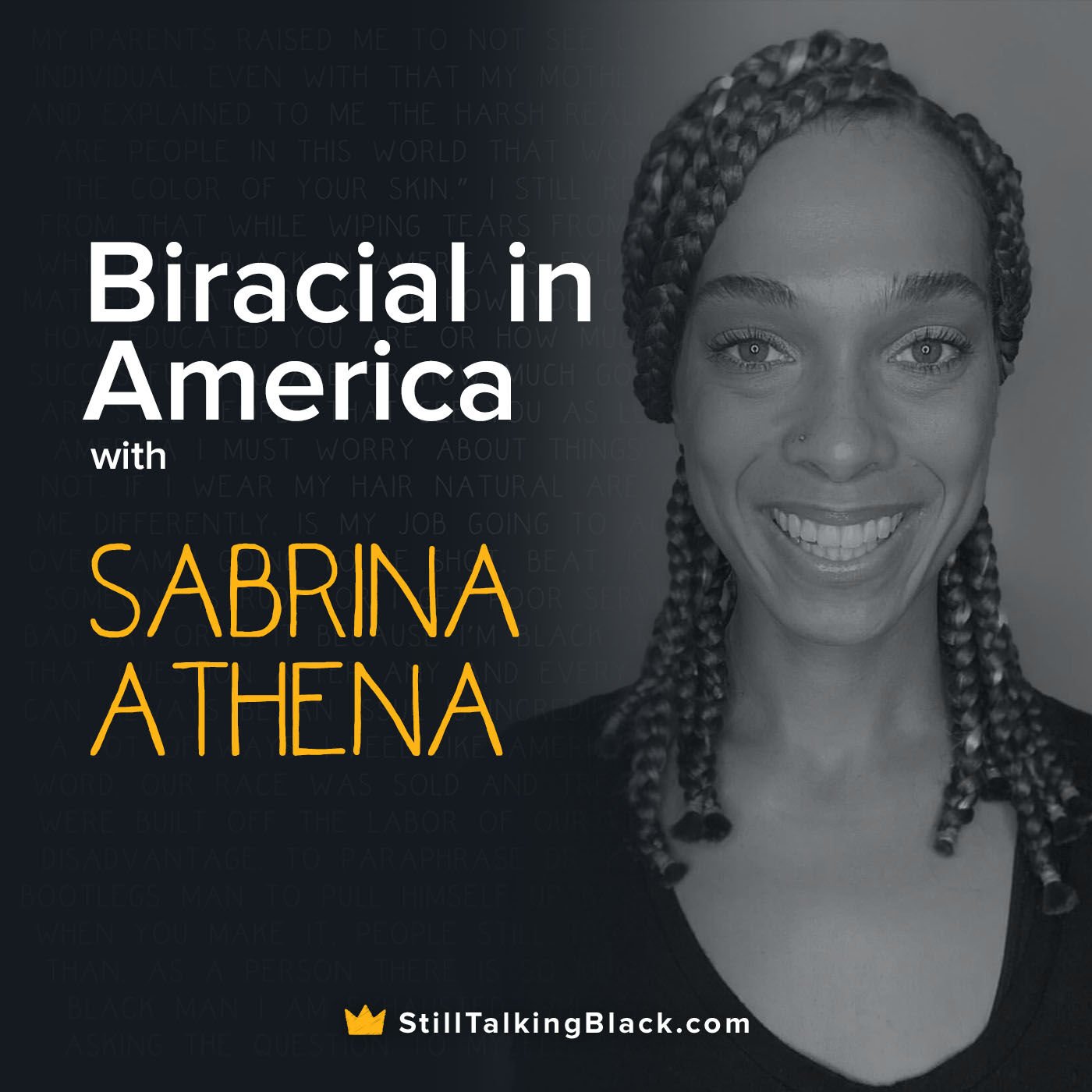
Episode Summary:
This episode is all about trying to understand the view of people that are biracial in America. Later in the episode, I talk to Sabrina Athena as she shares some of her perspectives on the film and modeling industry and talks about some of her experiences growing up biracial in America. Also during this episode, we play a poem from Cassie Poe called “Having Soul.” You can find the video of her performance here: https://www.youtube.com/watch?v=IVRr4EHnzWA&t=3s. Cassie now makes handmade jewelry, you can check out her store here: https://www.etsy.com/shop/beadmode.
Show your Support:
If you like what we are doing here the best way to show your support is by rating, sharing, and subscribing/following our podcast. Another way to show your support is by giving us a donation at BuyMeACoffee.com/CrownedCulture. We appreciate any and all support.
About the Interviewee:
Sabrina Athena is a very talented model, actress, and entrepreneur with roots in Detroit and Brooklyn. You can follow her on Instagram @TheSabrinaAthena.
Spotlight on Melanin:
This episode’s spotlight is on Mila Lynn. Mila is an incredible artist with a studio in Lansing Michigan. You can find her on Instagram @MindOfMila, and you can find links to her shop here: MindOfMila.com
Credits:
Host and Producer: Richard Dodds @Doddsism
Show Music: @IAmTheDjBlue
Episode Transcript
[00:00:00] Richard Dodds: Coming up later in the episode,
[00:00:02] Sabrina Athena: I don’t see myself being called out for being mixed. I, I see myself being caught up and being light-skinned. There are seven original shades in the human race and a black woman can have a baby of any one of those shades. So colorism. Where society shifts favor on a complexion, but doesn’t understand the origin of that rates.
[00:00:23] And we have fallen victim to that within our own community and with the beef between each other and you act and light skin and all that kind of stuff. It’s separatists and that’ll stand for,
[00:00:33] Richard Dodds: this is still talking black, a show about giving perspectives to issues that minorities face every day. I’m your host, Richard di.
[00:00:41] Once a day show, I’m going to be taking a look from the perspective of being biracial in America. Later in the episode, I will be joined by actress model and entrepreneur, Sabrina, Athena. And talk about some of her experiences of being biracial in America today. It may seem crazy that just over 50 years [00:01:00] ago, it could be illegal to marry the person that you.
[00:01:03] It wasn’t until 1967, that interracial marriages became legal everywhere in America. Just seven years prior, interracial marriage was illegal in 31 states, it would still be 48 more years until same-sex marriages were legalized. I know today is something that some of us may take for granted, but those freedoms were not always.
[00:01:25] Well prepare for this episode. A friend of mine introduced me to a poem by Cassie pole, where she says her perspective on being biracial in America. Instead of trying to summarize what she said, I reached out to her for permission to play her poem on the episode. So without further ado, this is Cassie Poe performer, her poem titled having so.
[00:01:53] Cassie Poe: There’s never an easy way to strike up a racist conversation. At least you think there wasn’t, [00:02:00] but it’s funny how many I managed to find myself in without even trying too hard. Well, I guess you don’t have to try too hard when you’re a walking billboard for biracial relationships, but still you think people wouldn’t be so blahzay about it.
[00:02:13] I mean, she asked me flat out, what does it feel like to be white? You do know that you’re white, don’t you? What is it like to be hated at least half of the time? Do you connect more with your white side? Because you look so white. Oh, with your black side, because you live around here as if that really makes you black.
[00:02:35] And is it true? What they say about white people? You know that they
[00:02:39] have no
[00:02:40] soul, your mother’s white isn’t she. She even went on to insinuate that any association with my own family was evil, that I should announce them immediately accept the inevitable and cleanse myself because it wasn’t my fault after all.
[00:02:55] And don’t, I want to save my soul under those terms. I’m not [00:03:00] so sure. So I asked her, what does it feel like to be black? You do know that you’re black. Don’t you? What is it like to be hated at least all of the time? Does it hurt? Is it something tangible? You can feel like 50 pounds of water pressure in your face, a buddy whip at your back or dirt under your nails.
[00:03:22] If you’ve clawed, clogged way back from the brink of death hall and have your throat slit in the name of white supremacy, can you imagine hanging from Poplar trees, like strange rotting, fruit to be cheered at, or having your children sold to the highest bidder with tears streaming down their faces. I beg you to protect them while you’re bound and gagged on the foot of an unrepented white man.
[00:03:40] Do you know what that must have been? Like, have you forgotten the fight for quality so soon the fight that not only your parents bled through, but so demand or did the struggle and for you on May 17th, 51 years ago, only 51 years ago. I can remember days like those as 5% of the white kids still attending school in the inner city, she [00:04:00] knows what it feels like to stand out in a crowd pale white face, long red hair and bright green eyes.
[00:04:05] Does she have so you’re damn right. She did. Her soul kept her back straight. When chubby mocha fingers pulled to her straighten locks and called her cracker or soul pushed her head up when cruel vanilla fist declared her a nigger lover, not worthy of their stature, her soul, and during the years of interracial hatred and four children later.
[00:04:21] Still keeps her going. Her soul is in me like a country, a proud Irishman, standing strong against depression and greed her soul bleeds through me. The song of my ancestors from coast to coast, spanning oceans and continents, things of my veins so loud. I hear little ELLs save their tribal drums, their war Christ, their bad pipes, and they’re pleased for freedom.
[00:04:40] So do I think I have, so, yeah, damn right. I do. I have the soul of many nations. How about.
[00:04:56] Richard Dodds: So many times we don’t realize how our words and our thoughts can [00:05:00] be harmful or how differently others see situations. We all have our own biases and perspectives, but I feel it’s important to look beyond that and try to better understand our fellow persons in high school. I dated someone outside of my race.
[00:05:14] I never thought much of it personally, but the way society was, it seemed like that was something that was a big deal. I remember telling my best friend that I was dating someone and she was. Then later laughing with him at myself, remembering that he’s biracial himself. So what some parts of society may have seen as a big deal to him, I was just dating someone that I liked.
[00:05:36] It’s good to have friends with different perspectives to show you that everyone sees the world differently based off of their own experiences and background. I’m thankful for friends like that. If you’d like what we’re doing here, I’m still talking black the best way to show your support as my liking rating and sharing our content.
[00:05:55] Another way to help us by making a donation, using the link in the episode description, we [00:06:00] appreciate your support. We are also looking for advertising partners. If you’re interested in a possibility of advertising on our show, please send all inquiries to advertise as still talking black.
[00:06:15] Sabrina Athena: Well, peace, everybody out there. You are Rocco, rich and Sabrina Athena. I am a entertainment specialist. I do television film production. I’m an actress. I’m a model. I am owner and founder of the goddess workshop, which is a series of workshops in a resource for talent in the Detroit Metro area. And worldwide, I have a lot of different hats, but you know, got us in the flesh piece.
[00:06:44] Richard Dodds: It sounds like you’re trying to take my job as a broadcast host to,
[00:06:48] Sabrina Athena: um, um, I’m refining and refining my skills and I can’t take a job as yours. I’m just trying to shine next to you. There
[00:06:54] Richard Dodds: it is. I appreciate that. So, Sabrina, one of the main reasons I wanted to bring you on is [00:07:00] because I feel like you have a unique perspective.
[00:07:04] One you are biracial. And two, you are in an industry that really emphasizes beauty and this world has crazy beauty standards. For some reason. I don’t, I don’t know why. What is something that you was people understood about you?
[00:07:20] Sabrina Athena: I need it. If there’s one thing I want people to know about me is that I absolutely have genuine city that flows through me and that can be good and bad in some cases, but you always get a genuine version of me and that can be hard to believe at times.
[00:07:33] And that’s, that’s kinda tough. Uh, it’s something that I constantly work on is accepting that not everybody is going to. Stand my presence, but it is genuine. If it’s, if it’s all love is genuine. If it’s all caution is genuine.
[00:07:50] Richard Dodds: How do you identify racially? Like if you’re filling out a form and it says race,
[00:07:56] Sabrina Athena: if I’m filling out a form and the government needs to know, or the [00:08:00] governing entity that is attached to sip form needs to know my race, I typically prefer not to answer.
[00:08:06] And that’s not because I don’t know how I identify, but it’s, to me, not their business. And I don’t want to, uh, contribute to whatever data collection, statistic theory they’re like doing, but I’m a black. If I find that this is, this is probably a way deeper answer than you just, you just asked me, like, how do you check the box?
[00:08:26] Well, it depends. It depends like a lawyer. It all depends. Um, Because if there’s going to be a box that said mixed race, that’s showing up a lot. Now when I was a young, young woman and a kid, even I remember my mom used to put forms in front of me and say, practice, filling out this form, check the boxes, write your name, put your address, make sure you know your information and how to neatly execute that with one of her lessons for me.
[00:08:54] Wow. For, um, my, my family actually. And I remember coming to that box and thinking, [00:09:00] well, what about. Do I check both boxes? Do I check, you know, no boxes? Um, there’s a Hawaiian or Pacific Islander, Alaskan. What? Like, okay. I don’t think I’ve identified that way. And so it just. Um, I chose the box that made the most sense for me.
[00:09:15] And now it was always African-American. Now that I have the more information and knowledge about it, and there’s additional options that typically choose to opt out or choose the box of the beneficial to my cause.
[00:09:28] Richard Dodds: So beneficial to your cause.
[00:09:30] Sabrina Athena: So for example, diversity hires and things of that nature, let’s say it’s a job application.
[00:09:35] There are legal things and human resources is an entire industry. Ended up as self away from the separation. Cor corporate conglomerates. There are very strict rules and very strict guidelines and how an a corporation is to operate in integrity, human resource professionals know these rules. Right. Right.
[00:09:58] So to me, [00:10:00] especially lately, the idea of diversity hire, I think, I think it got kind of constant. When they started allowing, oh, well we need to hire more foreigners. They’re not white, best diversity. Um, you know, we should, we should hire more, uh, more Indian people to do less labor job, you know, less cost labor jobs overseas.
[00:10:21] How does that help in my agenda as a black woman who wants to see more black women as a part of the diversity initiative,
[00:10:29] Richard Dodds: I totally get where you’re coming from with that as something that kind of always got me, you know, I never, ever wanted to be. And feel like I was there just because I’m black. I don’t, I never wanted to do that.
[00:10:42] Like when I went to school, I never wanted to be like, even when I, even though my grades were good, when I was walking around in the back of my head, I was like, people are thinking I’m here because I’m black. And they think they let me in. Not because I’m qualified, but because of the color of my skin and that always kind of stuck with me and [00:11:00] that always kind of bothered me.
[00:11:01] Half-ton to have that thought in the back of my head. And that almost gives you like a, in that particular case, not, not quite in that same context of what you were talking about, but almost gave me like an inferiority complex because I’m thinking like, Ooh, I didn’t really earn this the way that other people earned it.
[00:11:17] And the way of them fixing a broader issue was by making sure that they put more blacks in the school instead of, Hey, let’s make sure that all schools have the resources that they need so that no matter if you’re from the suburbs or the inner city, All of the kids can succeed on the same level instead of just like, Hey, like let’s make sure we got five black kids and, you know, a native American kid over here.
[00:11:41] And it’s always something that never really sat well with me.
[00:11:44] Sabrina Athena: Well, yeah. And that’s the thing we got to stay facts and speak truth. So the facts of these matters are that we were the, we were the only well outside of native Americans, but native, excuse me. Um, They are not native [00:12:00] Americans. Nobody, they did not call themselves American at the time, but the natives to this land were put in their own sense of treaty and whatever the case may be that we know still wasn’t even fair.
[00:12:10] But the struggle of the black man came down to. Okay. You see me as inferior on a historical level. You see me as a laborer and like a mule. I don’t have the rights to be educated. So within that, we are set back 400 years and now, although the attitude hasn’t necessarily changed color, the opportunity may have.
[00:12:33] And even if it is a diversity hire situation, our job then is to go ahead and. We are of a time where it’s up to us to not only be exceptional because that’s the exception, right? That’s the definition. Um, I am, I’m the exception and I get to be here based in, based upon the initiatives put in place and I’m exceptional on all levels.
[00:12:57] I’m excellent in what I do. And you didn’t make [00:13:00] a mistake by hiring me in
[00:13:01] Richard Dodds: here. I extra level that we have to push for. On a previous episode, I was talking to somebody about being a black. And we kind of talked about how, when we’re in an environment, Like black people always have to be exceptional. Yes.
[00:13:17] Think about like tiger woods and a predominantly white sport tiger woods comes and he has to be the best in the world. You know what I mean? So whenever it’s, it’s something that we typically aren’t in. In order for us to be accepted and our world, we have to be exceptional. Yeah.
[00:13:35] Sabrina Athena: And she’ll be told that’s something that bothers a lot of us, myself included for, for so many reasons.
[00:13:42] But I mean, if we take a look for example, at, um, a very, very easy example, how much do you think the, the common 16 to 30 hour a week television watcher knows about television production? Probably not a whole lot. Right? The stories that are being told on film and television. [00:14:00] I have been told through the gatekeepers and the eyes of a lot of Jewish people, a lot of white people, a lot of older men, you know, we got this Harvey Weinstein thing.
[00:14:08] He was a gatekeeper in the television and film community, which is very scary to know. And so this, this, this travel people, the time, the entire film industry, So where I was show up as a production assistant, just starting out and as me as one black woman, few black guys, maybe that are kind of like in transportation and then the rest of the set and all the easy kind of light work that, and none of it is easy, but any job that they would consider easy, like they’re drunk, highest net.
[00:14:36] Are sitting around doing nothing and just kind of keeping their job. And I’m like, why all they have to work. Right. And I’m hustling, I’m, I’m busting my hump. I’m making sure I’m like the best person there because I have an objective to be great. Always I’m never half ass, but then even beyond that is there’s work to be done and I’m looking to live and, you know, and, and really Hollywood is a funny industry.
[00:14:56] They, uh, they throw away a whole lot of money. They have [00:15:00] really, really big budgets and may have. Expectations of like elite entitlement. So it’s always, it gets a little interesting behind the scenes that I’m here to tell. There’s a huge paradigm to where you have these lazy people who have been granted access due to heredity, or, you know, just family ties or a network.
[00:15:20] And that’s all it is. But now we have opportunities or footholds where you can bring other black women in. You can bring other black men in and you can diversify based on your own focus because the opportunities are there. If you are a student have to take. Ah, that’s
[00:15:35] Richard Dodds: a solid point then. Definitely. Yeah.
[00:15:39] I dunno. I feel like sometimes we almost feel guilty doing the same thing that’s been done by other people for years. It’s like, I don’t want to put you on just because you, my cousin or just because you look like me, but I feel like it’s something to
[00:15:51] Sabrina Athena: that. And, and not only is there something to that is proven, right.
[00:15:55] And, and keeping in the example of film and television production, I think this is a [00:16:00] cool way to present. We didn’t have access to the kind of money it took to produce. Content the way that we can now on a much cheaper budget with the same level of quality. Now, mind you, the really super expensive stuff has evolved.
[00:16:15] Even past that. However, we’re finally able to get a sketchpad, right? To put our ideas finally out there. And when black people come together, minority people come together. We are very resourceful and we make the most out of what we have and we have dope. With now we have collectives. Now we have entire organizations solely dedicated to the, the melanated of the TV and film industry.
[00:16:39] We need some melanated because our stories need to be told by us,
[00:16:44] Richard Dodds: tell our stories for us.
[00:16:45] Sabrina Athena: Right. Well, we already know, and we’ve seen what that looks like, but we are very resourceful and, and our production are written better. Our productions have more heart, it have more connecting to the audience, our production.
[00:16:59] [00:17:00] Are a different vibe and a different soul because they come from a different place, a different team, those lazy production assistants. Aren’t there. We’ve got people who believe in the, in, in, in, in what’s happening and they’re willing to put their time and effort and work into it. And it’s hard work producing.
[00:17:17] And I mean all the way from a tick top, all the way up to a short film and beyond
[00:17:23] Richard Dodds: seriously thinking that some of these people that I put up a picture that they’re just taking one picture and putting that up for yourself,
[00:17:31] Sabrina Athena: don’t you do it. And in fact, I challenge you to take whatever your passion is. If you have that entrepreneurial spirit and build.
[00:17:40] So meaningful, um, social media presence to, to utilize that free advertising and free marketing and be clever, man is hard. It’s so hard, especially when you’re the talent. That means that you, you know, you got to manage all of it. You’ve got to make the decisions. And even still as a talent, I recognize, I, you know, you need a team.
[00:17:59] Richard Dodds: [00:18:00] Yeah, you definitely do. Have there ever been times where you felt like you weren’t accepted because you’re biracial, like you, you felt like maybe you haven’t felt, and with one, once I go group of people, I
[00:18:12] Sabrina Athena: would say that we have to be careful about confusing culture with collar. So in a sense, what I mean by that is, and I think this is what I mean by that.
[00:18:22] I’m getting it as I go here. There’s a difference between okay. Class and culture. There’s a working class that is blue collar. There’s a corporate class that is white collar. Anybody who never knew that, that’s what that means. When they say, what color collar are you talking about? A lot of times, especially in a city like Detroit, you end up having.
[00:18:41] Culture of blue collar that has nothing to do with race. It’s, it’s everybody in this pot together, that’s making the $12 an hour. You know, if you at the plant, you might make 1720 something an hour, but it’s still enough to get by and live in a decent house that may have some roof issues in Detroit. You might, you know, be all right [00:19:00] with a little car note and everybody eats on that.
[00:19:03] And everybody operates in that. And that has nothing to do with black. But a lot of people related to, oh, well you acting black or you acting this that you act according to your color, you, you act according to that, all that being said as a, as a black woman, I don’t see us. I don’t see myself being called out for being mixed.
[00:19:22] I, I see myself being called out for being like.
[00:19:26] Richard Dodds: That that is a, that is a take cause people do. When we talk about beauty standards, we people usually do attribute light skin to being a more
[00:19:34] Sabrina Athena: beautiful. Yep. Yep. And those are European beauty standards and that’s where we are as a society. Because again, take the facts, speak the truth.
[00:19:43] The fact of the matter is a woman as light as me, or as dark as electric. Look her up. She’s a supermodel. You got it. Uh, liquid with the short hair. She was one of the first supermodels with the dark skin. That gorgeous, big smile she has, [00:20:00] and just amazing, amazing, amazing. Do yourself that favor, but she can have a baby as light as me.
[00:20:06] There are seven original shades in the human. And a black woman can have a baby of any one of those shades. So colorism comes in where society shifts favor on a complexion, but doesn’t understand the origin of that race. And we have fallen victim to that within our own communities. And with the beat between each other, that you act in light skin and all that kind of stuff.
[00:20:32] Very separatists and that’ll stand for it
[00:20:35] Richard Dodds: all the time. I heard people telling me that, oh, you’re acting light scanner. Like you just put in a whole group of complexities together and saying that attributing a whole characteristic to that.
[00:20:46] Sabrina Athena: Yeah. And actually I just got done. I had to watch this two and three times.
[00:20:51] I’m a, I’m a comedy nerd. They Chappelle is my hero. And even if he wasn’t, I would agree with him on what he just did with the. Yeah. He, he [00:21:00] allowed us the grace of an explanation in hopes of some understanding that it’s not that I’m saying F everybody else is, I’m saying why can’t black people get that same love.
[00:21:09] So there’s perspective that he’s, he’s looking to, to instill. On us that will either be accepted or rejected, but I’m sure he’s made his, um, demands well-known in advance about whether or not it’s going to get taken down. Cause he understands, we all knew it was going to happen, but, and Paul Mooney is someone I worked with for several years.
[00:21:28] And so as an honor to him and his influence in my life, I have to take that, uh, that mentoring at that again, I’m making all these words that today, but that, that. The knowledge that he’s instilled in me for whatever reason, the unit first off it and stand on what it is that makes sense to me. We have colorism because we have beauty standards that are accepted or not.
[00:21:52] And then you end up, somebody is favored. Somebody has a different experience. You see someone dark skin, they go in and you see someone life’s going to go, oh, she’s [00:22:00] pretty, whatever the case may be. If not, it’s not. Really what the outside world is like, thinking about us. We got to know what we think about each other and that radiates from us.
[00:22:10] I know when someone says you act in LifeScan where the mentality. And I don’t even react is more like I see where your level is that, and I respect your space and I’m gonna keep it over here.
[00:22:21] Richard Dodds: That’s just not a level where you want to occupy
[00:22:24] Sabrina Athena: with them. If I’m filling my glass and it’s half full and I’m continuing and rotten, there’s no oxygen for you in the bottom of that glass.
[00:22:31] We moved on.
[00:22:33] Richard Dodds: That makes a lot of sense. That’s a. Definitely a definitely a different approach from how you hear other people talk about that type of things. That’s a very, I feel like that seems like something that that’s something that you’ve thought about quite a bit. Maybe you had to deal with it quite a bit, to be able to have that level of understanding of it the way that you do comes
[00:22:53] Sabrina Athena: from a lot of different experiences.
[00:22:54] And it’s beyond just whether or not I’m light-skinned to be accepted amongst my community of black people. [00:23:00] But even beyond that being accepted in modeling as a plus model, and I’m barely a size 10, like I’m pushing the 12, the curvy community and modeling has grown by leaps and bounces at the time I started.
[00:23:13] Okay. Let’s get that out the way. I’m not a young model, a young model, but I, but I have some value in, in wisdom. And, um, and if somethings it’s still contributing, which is why I still work, but what I’ve learned along the way is they all they’ll reject you for any reason you allow. You have to accept yourself.
[00:23:33] I know I’m not the, the typical curvy girl, but that’s why I’m not booking the same things. You book insists. We got two different looks and we got two different clients and two different realms of what they looking for. And even now emphasize I am as a model, I’m still, I’m still kind of curvy, but they’re calling it now in between.
[00:23:51] So now there’s a whole nother division. I’m an in between, between, you know, a size 12 and a size. Anything between those two sizes, what [00:24:00] most people would have considered to be quote unquote, normal. There’s more space for it now because the way society swings and the way the events of the world affects our vision and the way it shifts everything we are looking at, we want, we demand realness.
[00:24:15] So now the industry is going to allow us to have more real misrepresentative because it’s the gatekeepers had a finger on the pulse. They know what. And they know what, they don’t know what we need. They th they, they know what they’d like us to need. And therefore they’re doing their research very carefully.
[00:24:30] They’re looking at the boxes. We check off all forums. They’re looking at what clubs, we’re a part of have subscriptions. We have those terms and conditions, but a lot of these companies, you would think, oh, I just signed up for an app and it’s a video editor. Heck yeah. I signed up for the video editor because I need my content point.
[00:24:45] Right. But get, but guess what else? That app is not just making money from your 3 99 a month contribution. They’re making money from selling your information and it’s specific and is great for the person. Who’s getting it on the other end because they know [00:25:00] exactly what it is that you do and how you do it and what, and what you’re doing.
[00:25:03] So it all, it all works together.
[00:25:06] Richard Dodds: A lot of times,
[00:25:07] Sabrina Athena: actually. Not even all you selling different sheet, you’re paying for that.
[00:25:10] Richard Dodds: Yeah. Okay. That’s it that’s even worse. Right? It’s like I heard somebody say whenever you’re on something and you’re not paying for it, and you’re trying to figure out what the product is.
[00:25:21] You had a product. Is you, you are the product.
[00:25:26] Sabrina Athena: I think, I think your original question on, on this. Um,
[00:25:32] if I had, um, experienced any of that kind of like colorism or hate again and, and really to sum it up, it’s not that I haven’t experienced it, but I just understand it differently. And my perspective isn’t rose colored glasses. It’s just, like I said, and, and, and I’ll probably say a seven more times throughout this interview, state the facts before.
[00:25:51] The facts are black people come in, all shades, the facts are black. People act real ignorant towards each other based on racism, which then produces colorism, [00:26:00] which then, you know, seek to divide and conquer us as a community. And I’m not here for it
[00:26:09] Richard Dodds: who want to fight, who want to fight each other? How are we going to fight each other, like as so many other people trying to fight us
[00:26:14] Sabrina Athena: that should, that should be the mentality we can govern ourselves accordingly.
[00:26:19] Richard Dodds: So speaking of fighting with all of that racial tension going on recently, how has that, how has that been for you?
[00:26:25] Do you deal more with people from both sides that you have to hear both sides and are both sides? Oh, I’ve got to hear
[00:26:31] Sabrina Athena: none of it if I want. So I’m gonna tell you right up,
[00:26:38] but, but my, what I have allowed myself to, to digest cause I’m good at protecting my peaks. I would definitely say that my first I did take that this. Started at the end of the Bush era, Barack Obama being the leader of the free world and also considered a black man, definitely raised some [00:27:00] eyebrows in, and that was 2008.
[00:27:04] Richard Dodds: Like they called him a black man until he won. And then he was biracial. Our multi, multi ethnic, they kind of changed the way that they classified him after
[00:27:14] Sabrina Athena: he won and communities and pockets. I don’t think that that was, I don’t think it was clear across the board. I’ll tell you that much because in some, in some communities, he was our first black president.
[00:27:25] And then I think if, if I’m being correct on the political level, he was then known as. Um, well, his father was from Kenya and his mother’s from Hawaii. So now, so now they didn’t classify them, but they started explaining, start explaining stuff. So, you know, if you want to get downright technical about it, would Kenyan necessarily be African-American.
[00:27:52] Um, okay. And then his mom was born in Hawaii and, you know, know. Okay. So, um, so now you’re, you’re leaving it up [00:28:00] for interpretation, but China
[00:28:01] Richard Dodds: slick. You’re not trying to just straight up say it, but you’re just insinuating like, think about it. We’re just going to put this on the table and just give you directed
[00:28:09] Sabrina Athena: commentary, right?
[00:28:11] Yeah. You guys make that choice for yourself now in modern time. Not that the time then wasn’t modern. Kamala made it very clear. Do not call me the first black vice president or the first woman. Well, yes, first woman vice president shore, but black. No, I am this and this and this, and I don’t agree or identify all opinions aside, you know, that’s how she chose the rocket.
[00:28:36] But your question too, how has the political climate in recent years affected me personally? It’s really more an observation and yes. I have family members on both sides that says that have opposing complete opposing views. Some, some not so opposing, but kind of confusing. It’s like, okay, you want to be down well, black lives [00:29:00] matter, but you didn’t, you haven’t invested in, in anything to get to know more about that black community outside of I’m your niece or, um, or, um, you know, I’m your friend.
[00:29:10] Uh, and, and it gets, it gets interesting because there are. Sutras many threads of this type of experience that can go on. And it’s almost like endless. Yes, it is out there. Yes. The temperature is turned up. However, protecting your piece is beyond anything. If you don’t know how you feel about something, that’s okay.
[00:29:29] If you don’t have a political stance about an issue, you know, there’s a new issue every day. Don’t stress yourself because this moves is unlike it’s ever been. We gotta be very careful about what we allow our irrigates and our hearts and our minds and the messages that we receive, because you’re, your temple is sacred and you’re going to produce things based on influence, which you consume.
[00:29:53] So I, I take that into high, high consideration and, um, it’s out there, but I’m like until I know [00:30:00] how I feel about something, I’ll speak on it
[00:30:02] Richard Dodds: as came to be. I talk about on my, on the very first episode of the show. The podcast came to be after George Floyd was murdered. Right. I did a speech and I’ve always been around people of different ethnicities, people of different backgrounds, people of different races, religions, whatever.
[00:30:21] I’ve been around a ton of people. So, you know, I try not to think about race that much, but that particular thing caused me to want to speak out in a way that had never spoke out before, just because the, the landscape of the world started to change. Everything was changing. And the thing that I remember is just like being a PA, putting your point out, having a point and having something, even though somebody, even though people of different races of me, you know, I’m not going to point out one different race, you know, that they love me and they know me.
[00:30:51] It’s like, just because of me speaking out for my race, speaking up for my people saying that I feel like. A lot of times we are treated unfairly because the [00:31:00] color of our skin and it’s, and its weights that we have to carry as black people that other people y’all don’t know about it. Some of y’all don’t know about it.
[00:31:07] If y’all, if you’re, if you’re a white male, you really don’t know about it most of the time, unless you’re really trying to look for it. So it just kinda, I remember putting it out when I posted it, I was so nervous just because like, how will people interpret this to me? It’s like, well, they’re paying, even though they’ve known me for years, would they opinion.
[00:31:27] Luckily, my circle was good, but I mean, at the same time I could weed out anybody who shouldn’t be in my circle, because if you can’t accept that, then you can’t accept me.
[00:31:37] Sabrina Athena: And I would say that’s really binary though. I think that there’s a lot of nuances that make it okay. Because again, it’s like the sutras it’s like principle is a tree.
[00:31:46] I feel like there’s so all the way out to the, to the, to the limb of the, of the, um, leaf, you know, to the very tip of the leaf, the principle, there’s a tree you start with. You know, uh, am I for, or against [00:32:00] abortion and say, well, I’m not really for abortion, but I’m not really gifted. So I guess I’m pro-choice okay, cool.
[00:32:08] So are you for or against abortion for, you know, people who get. Oh, well, probably paying. Yeah. I wouldn’t, that’s a crazy situation. I would want them to have a choice in that. Okay. So then are you for, you know, people who have gotten raped and then our inmates, like, okay, all right, we are getting endless with, with this, you know, what do I, what do I stand for and not?
[00:32:28] And, um, it’s not always, so just this. There are a lot of nuances that make up those situations. But I think really what it comes down to is a respect for someone’s opposing opinion and not feeling the need to challenge other people into believing what you believe. And that is more prevalent than ever. I think we talked
[00:32:49] Richard Dodds: about you and I have talked about this before, but being able to, okay.
[00:32:54] I don’t know. I don’t agree with you. You don’t agree with me. I still respect you though. It’s [00:33:00] now, it’s kind of like, you have to be, if you don’t agree with 100% of everything that I say, then we not cool. And this
[00:33:07] Sabrina Athena: needs to be able to accept, be accepting my opinion and viewpoints and respect me as a person and an adult that has made a decision and has come to a, a principle to understand that we can have discussions about it all day, but people are very reluctant to.
[00:33:25] Be at peace with whatever it is that person is about dealing with it, going through, you have a completely different circumstance in that other person, and
[00:33:33] Richard Dodds: you don’t know what that person is going through. Right. You don’t know what that person is going through. You. If you grew up in a nice household and you went to a nice school and you never had to worry about where your next meal was coming from, and you know, you graduate, you go to college, you’re going to think a completely different way than somebody who grew up.
[00:33:56] And they had to fight for everything that they got and [00:34:00] they couldn’t go to college because they had to help mama pay the bills. Your perspective on the actions that they make versus the actions that you make are going to be completely skewed. If you hold them up to the perspective that you hold yourself.
[00:34:11] Very
[00:34:12] Sabrina Athena: true. And to add on to that, there are people who aren’t as polar, that we put generalizations on the polar opposite of rich wealthy go to school that are the things that we should think of as you know, even if it’s a struggle, those are good things to do. You know, this is the life that we want and this, you know, and then the opposite of that.
[00:34:35] Not having as much access to resource and, or having to fight really hard or work really hard or wake up really early to get it. You can have a person who had a two pair of household median income of 150,000 lives in a ninth house in the suburbs had a good education. However that parent wasn’t available or the other parent, because they had to work a whole lot.
[00:34:58] So they got tripped up in [00:35:00] drugs and that, and so you just had the small little deviation and that’s not a small one, but you have a deviation from what we would think of the like, and then immediately that person becomes someone who we write off because we don’t understand their struggle. They got their struggles soon.
[00:35:12] Now my mind do, they might not look like ours, but everybody has a certain level of capacity. Everybody, everybody is an individual. And so those stereotypes or those assumptions that might make about the first person we spoke to and, you know, with, with best the same or similar situation, it’s not fair to put that same expectation on someone who is even similar to them.
[00:35:31] Richard Dodds: That’s very, that’s a, uh, excellent point. Yeah. Um, every little thing, I feel like our society always tries to put people in the group. And it is something that is psychological about putting people in the groups because easier to be able to recognize traits in the group than it is to try to recognize each and every person as a person, which is crazy in itself.
[00:35:54] So I’ll always try to do the opposite. I try to get to know a person as a person and try not to group [00:36:00] them. And I feel like it’s even more, I even try to do a more so just because I know a lot of times I get put in a group, you know, I I’m a, I’m a black man. I’m about 6 1 6 2. My hair’s locked people gonna automatically think something about me.
[00:36:15] They’re gonna make their decisions before they even hear a word that I speak. They’re going to have a image of what I am made up in their mind already. Just like, just like when they see you, they going to see you. And like piling. Some people will probably look at you, but oh, she cute. She thinks she cute.
[00:36:31] She carried me. She probably sold boozy. You know what I’m saying? Like, people will make up stuff in their mind before they meet you and then they will treat you based off of their expectations. Yeah.
[00:36:40] Sabrina Athena: Yeah. And that’s, and that’s the thing about life. Life is about anticipation and managing expectations working.
[00:36:47] You anticipate from walking up on me, coming up on the street, that’s for you to decide you manage your expectations based on what you anticipate. And so if you’re disappointed, you. You anticipate is something that wasn’t [00:37:00] necessarily factual about me. That was your true cause because unlike I like to make those really simple terms and use them in powerful ways because facts are the events that they happen.
[00:37:10] Truth is your interpretation of that. So when it comes down to it, the facts of the matter who I actually am, who you actually are, we all know until we encounter whatever. If we decide to even have a whole conversation, cause that might not, might not even have the opportunity to prove your stereotype wrong, but if you’re present and you allow the moment to pass and you ha you know, unless it’s something positive to reach like your curls, curls, you know, that could be a passing, just, you know, something humble in, in a connective moment between humans that’s valuable versus, you know, and, and the challenge here is to not.
[00:37:47] Can I use your negatively conditioned mind out in public so much B B keep your head on the swivel by all means. But it’s like that, that conditioning to always being negative about somebody walking by, or like, you know, feeling [00:38:00] some kind of insecurity or imposter realism based upon someone else’s achievement or things that you see in them that you want nothing to do with that other person, if anything, internalize it, allow that to be your.
[00:38:12] Moment of consideration for things that you want to do to be closer to the person you are envisioning yourself. It was beautiful.
[00:38:18] Richard Dodds: I was just sitting here shaking my head. Like you can’t hear me shaking my head, but I was like, I was agreeing with you. I was, that was very well said. Growing up. Did you feel comfortable or on both sides of your family and that it’s funny to think about that because both sides of my family is black and I’ve always felt uncomfortable anywhere that I go.
[00:38:37] You know what I mean? It was just odd enough. So,
[00:38:41] Sabrina Athena: and I know this isn’t a Cole interview, but I want to know the direction you’re going to hear. If you don’t mind, just give me some example of how you felt uncomfortable growing up in a duel black household or.
[00:38:51] Richard Dodds: Uh, I guess a and a dog and a dual black household, I felt uncomfortable in a ways that I, I don’t know.
[00:38:56] I just never really felt accepted for who I am. And [00:39:00] I just actually recently saw something. It was a Tik TOK where a psychologist will talking about why you get angry at family because family, the long story short of it, it was a pretty long tic-tac. But the long story short of it was that family sees you in a certain light and it might be the 12 year old.
[00:39:18] And now you’re in Adele and it’s still holding you in the light of a 12 year old. So me growing up, that’s why I was super uncomfortable. I still like I’m getting better, but I still, I feel like I don’t feel like myself around family.
[00:39:33] Sabrina Athena: I can understand that. The black belt negation has a way of, uh, there’s unspoken rules by region.
[00:39:43] The Southern blacks are different than the Northern blacks, but not too much because we came from the Southern blacks and the Western blacks are a whole different kind of confidence, you know, a whole different kind of Oakland there’s there’s there’s communities and pockets. And if you think of it from a global perspective, the American black [00:40:00] population is very variable.
[00:40:01] We have our own culture that rocks the world. Um, and, and there’s maybe 10 cities that represent us in the best light. So that’s that in itself is incredible. If you look at it from that perspective and, and I’m glad you mentioned that you feel uncomfortable even as a black man coming from two black parents, because we have certain standards of what we believe black should look like because, and it’s out of trauma out of trauma.
[00:40:26] There was a woman that I knew who was from Fort Myers, Florida. And she had migrated north based, you know, that that industrial revolution came about in Detroit with pop in. So her people moved up north and got on the mind like everybody else, you know, the getting was good. And as I’m talking to her, I recognized that this woman is very jazzy and we all know this.
[00:40:47] Right. If you, from one of these cities, you know, this woman she’s about in her maybe early sixties and she’s well put together, her hair is never out of place, but she’s out fast. She got sparkly belts, the nice [00:41:00] nails, the nice shoes and everything matches. And, and she, they’re not be seeing anything less than well put together, even if it’s ongoing outside for a while.
[00:41:08] In my household, I grew up where my mom was like, I’m putting your hair in a braid and you have puffy bangs and go live your life. You can go outside and play. You’re going to scrape your knee. That’s why I was stuck to tomboy. I still climb trees. So this just didn’t didn’t resonate with me the way this woman was.
[00:41:27] So I had a conversation with her and I asked her what that was about and, you know, The importance of just being so very polished. I can understand at that point in my life, I w I’m I’m, I’m still evolving as a woman and I’ve take, let me not say I take, I receive wisdom and I absorb it from wherever I can get.
[00:41:46] And so these conversations come up in my life frequently, thankfully, and I’m like, you know, what’s going on? Like, I don’t, I don’t care about all this stuff the way that some people do when I see you do so, why her explanation was that growing up in Fort Myers, Florida. We’re [00:42:00] talking about a state that rose would happen.
[00:42:03] Then we’re talking about a state that pirates happened in all kinds of stuff is popping in Florida. But, but one thing that track consistent throughout the population of black people in the south is that you’re seeing it’s like less than already, because you’re all, you know, we have a mentality of you being the, the, the muscle.
[00:42:24] You are, you know, you were property and you got free and you’re still dirty. So when you step out, they already have a visual stink of you. If you at least step out in a way that is beyond presentable, you’re, you’re setting yourself aesthetically apart from the judgment that may come with you being less than.
[00:42:46] And they have to straighten their back up a little differently when they talk to you, even if they still going to call you in word, you know, whatever the case may be so that you just never wanted to prove them, right. You always want to step out and give your best [00:43:00] because, um, and, and that, that term Sunday best comes from the, the fact that we had three outfits.
[00:43:06] Maybe back in those times where we were still on the plantations, you had your work outfit, you had, uh, maybe two workouts as a one church. That’s your Sunday best. That’s what you wash every week and you curl your hair for, and you come and you give God the praise and the way the white man done taught us as a whole nother thing.
[00:43:23] And you give your Sunday best. So that was her explanation and it definitely sat on my spirit and I digested and I could understand. Where she was coming from, and I was able to adapt the best parts of that within myself and have a little bit more, it takes a village to raise anybody. And don’t ever think that you can’t learn anything from anyone.
[00:43:41] You know, even, even to this day, my mother will look at me like, where are you going? I’m like, I just, I just got dressed a little differently today. Mind, you know, I have a, I like, I like going out and feeling a little better about myself because I’ll dress up a little differently, but that wasn’t my initial culture.
[00:43:56] So there’s definitely that we have to be conscious of the [00:44:00] way we present ourselves. And I think, I think I want to land
[00:44:03] Richard Dodds: there and relate it to both sides.
[00:44:08] Sabrina Athena: Absolutely not. And I’m going to tell you like this, my experience, my cousins on my wife’s side are the sons and daughters of afforded. Exactly. That I grew up around and they, they fell into some pretty heavy, heavy stuff that a city is didn’t.
[00:44:23] Our experience was crisscrossed and that you would expect a little girl off seven mile, south field freeway may find themselves into some different things, you know, because that neighborhood has ghetto or whatever. And they live out in the burbs and Dearborn and it’s all beautiful. And they got a pool and air condition.
[00:44:41] But they also have access to the resources for different types of entertainment that I didn’t necessarily have, nor was I interested in if there’s anything, I didn’t feel like I aligned with it was with my white side. I, even to this day, I I’m, I’m working through some of that because it was always really [00:45:00] lame to be, you know, called white where I’m from, you know, it’s like, it’s, it’s it.
[00:45:05] Wasn’t like, I’m like, yeah, I’m a black woman that. They’ll do that. And so just being transparent, I just, I didn’t align with that side of my family. I didn’t understand it as much. I was so into hip hop. I was so into poetry, Erica Badu with my auntie, you know, I’m an athlete and that black people all over.
[00:45:22] It just didn’t, it didn’t resonate with me, this, this culture of whiteness. That to me, wasn’t even better than what I was doing. So, yeah. As far as acceptance is concerned, definitely on that side of the family, there was some conversations about w you know, I’m the only mixed cousin on that side. And then on the other side, I’m still, also the only mixed cousin.
[00:45:43] So there’s not like, you know, a whole range of different mixed people throughout my family. It’s like, I’m a mom. And that we’re the only ones to kind of come into that relationship. And so, you know, I have aunties that treated me differently coming up. I have aunties that were wonderful. Immensely a part of my [00:46:00] life that are now hopefully also Trump supporters.
[00:46:03] And y’all like, you know, fill in the blanks. So it’s interesting how the political divide also then adds the family to, by societal the buy. And I don’t care what nobody say. I’m a quote, Como Cuomo and, and Yahoo. But I believe what he said back in, back in the pandemic, back in, back in the pandemic as if we’re not out of it.
[00:46:22] Right, right. Right. At the beginning, when New York city was starting to see these numbers increase by the thousands in a day or hundreds in a day, Cuomo said, this is not a political issue. This is a public. Issue. If we politicize a public health issue, we will be very, very sorry. And he challenged at the time, the president and the way in which he was moving.
[00:46:45] And he put it out there every day. Cuomo had an update at like two o’clock or four o’clock or something like that. And as a new Yorker, I’m literally just sitting here and livestream at CNN as much as I can through my little apple TV, seeing what the heck is going on hour by hour. [00:47:00] I was like, I, they go shut down at airports.
[00:47:01] Are they? I mean, if they closed them bridges and tones, I need to get up outta here and I’m not going to trap me on design.
[00:47:06] Richard Dodds: Nope.
[00:47:09] Sabrina Athena: Not today. But Cuomo quoted that. He called it. He said, look, you all politicizes as, as a political issue, we’ll be all very sorry. And I think that we have seen what the effects of that are.
[00:47:21] And I think that that, that applies to race theory in America is not a political issue. But don’t, don’t, it’s, it’s really a mental health issue. It’s some community issue is so much deeper than just the political overlord that, you know, we need to vote because we need to make sure and be educated in our vote because we need those people in office to speak on our behalf.
[00:47:43] We have our representative, there’s the house of representative arbitrary title. That’s a title that, that means that they represent our voice. So we need to research the candidate. Promote the candidates support candidates and put them in place to actually have effective campaigns. And we know it’s all about.[00:48:00]
[00:48:00] A dollar, if you don’t have so many millions of dollars, you’re not going to win and I’m getting off on the tape.
[00:48:06] Richard Dodds: No, I mean, I like where you’re going with it, just because I remember the last election that we had. I knew people who didn’t want to vote and they were saying, I just don’t want to pick the lesser of two evils.
[00:48:16] And I’m saying for now we picked the lesser of two evil evils. But if you really feel that. Then it’s time for us to rise up and find people who represent us better than the candidates that we have, and then come together and put them in a place where they can succeed and that we can vote for them instead of the lesser of two
[00:48:33] Sabrina Athena: evils.
[00:48:37] Represented and supple put a best Asian hated the issue, Asian, that Asian hate thing, and people being irritated because we got this swine flu, we got all these other things happening. Yeah. That’s an issue. People are being very, uh, and, and have been historically violent towards Asians because of certain different, you know, uprisings or whatever.
[00:48:55] But I’m not mad that the Asians are getting shine. That’s cool. But why can’t [00:49:00] we, why is it easier for Cassius clay to change his name than it was for Caitlyn Jenner to. Her gender and identity, and then be voted as woman of the year. It’s okay to know where you stand. It’s cool to stand for your cause. It does not mean F them.
[00:49:15] It’s just, why
[00:49:16] Richard Dodds: not us? It’s the same thing with the black lives matter. It’s like, it’s ignorant to think if you’re not black, that by saying black lives matter mean that other lives don’t matter. Of course, all lives matter, but black lives have been getting taken more than any other life. So if you have a disparity of the amount of people that are getting killed and.
[00:49:40] Event then yes, we’re going to have to rise up like our lives matter too. It’s not like, oh, you’re alive. Don’t matter. It’s like, look, everybody’s lives matter, but y’all treating us like ours don’t and you need to recognize us. That’s why I really hated that blue lives matter and all of that stuff, because they missed the point of the whole movement.
[00:49:59] [00:50:00] They didn’t understand.
[00:50:01] Sabrina Athena: Not, not only did they miss the point, but it’s insulting. It’s insulting because you did not hear me, you and hear what I said. I said black lives matter. So that has not just started because, uh, my prints that didn’t start with Sandra bland. I did not start with George Floyd. It did not start with any of the victims of police brutality that have brought us into this place.
[00:50:21] It’s it’s saying that there’s a stark. And the way that we are handled is that there’s a difference in, and we’re sick of being ignored. And then on top of that, once we actually do get a little traction to say, black lives matter, oh, well, how arrogant is it for you to just ignore, brush it off and say, well, all lives matter.
[00:50:38] That’s just ridiculous. And how dare you try to really, you aren’t hearing it. And then to turn it into blue lives matter, blue is a. Black is not. You chose your profession. You chose to put your life on the line every single day. And we know that cops aren’t bad cops. We have uncles, aunties, moms, dads, and law enforcement and [00:51:00] police and authoritative figures all over this country.
[00:51:03] We know generals and women who astronauts. It’s not to say that. These people aren’t represented in this industry, but by far, be it for me to say that your choice to put your life on the line every single day has nothing to do with my rights as a free citizen of the United States. Why are civil rights, uh, a necessity in the first place?
[00:51:24] Think again, think about what you’re saying. Civil rights, rights disability. Wow. Why is that necessary? And who are we talking about when we talk. Civil rights. Wealth needs means rights where their civility in this country.
[00:51:41] Richard Dodds: Well, you talked about Dave Chappelle and you talked about, uh, your former mentor, Paul Mooney, thinking about it.
[00:51:47] I feel like comics are able to say this stuff in a funny way, but at the same time, be able to speak to
[00:51:54] Sabrina Athena: do the history. And Paul Mooney know your history. Mooney will know that [00:52:00] statement, know your history. And he said, um, W he breaks down history in a historical funny way. There’s just, there’s a lot of history behind where we are at this point in our history presently that has to be accounted for when you shun the idea that black lives matter.
[00:52:17] And that shouldn’t be said, so now let me mimic whatever you’re saying. Because I don’t agree that you should have a platform to say that we matter. It looks
[00:52:29] Richard Dodds: at marina. I could talk to you all day, but I really appreciate you taking time out to talk to me. I really appreciate you being on the show. Thank you so much.
[00:52:37] Sabrina Athena: Definitely. Thank you again for wanting to spend this time with me and, and allowing me a platform to put my little thank you opinion in, and I appreciate it. I look forward to coming back another time.
[00:52:51] Richard Dodds: I like to put a little spotlight on Melanie spotlight on melanin as the part of this show where I like to spotlight a creator, influencer [00:53:00] artists, business owner, or activists of color today, I would like to spotlight Mila Lynn Mila is an incredible artist with a studio in Lansing, Michigan.
[00:53:09] Last June team. She created limited edition t-shirts that red black is king king. I was lucky enough to get one, but so far, my favorite work of hers has been her blackest king collection of paintings and a style of playing cards featuring the likes of Barack Obama, Rosa parks and Trayvon Martin. Just to name a few, you can follow her on Instagram at mind of Nila and that’s M I N D O, F M I L A, or you can visit her shop@mindofmila.com. If you are someone, you know, would like the chance to be featured on spotlight on melanoma. Send us an email@spotlightasstilltalkingblack.com. Please include links to their social media and why you feel like they should be spotlighted. So again, I would like to thank everyone for listening, still talking black as a crown culture media, LLC.
[00:53:58] It is produced by me, Richard [00:54:00] Dotts. Our theme music was created by the DJ below. Please make sure to rate and subscribe to the show in your favorite podcasting app. You can follow the show on Instagram and still talking black, but until then, keep talking. .