
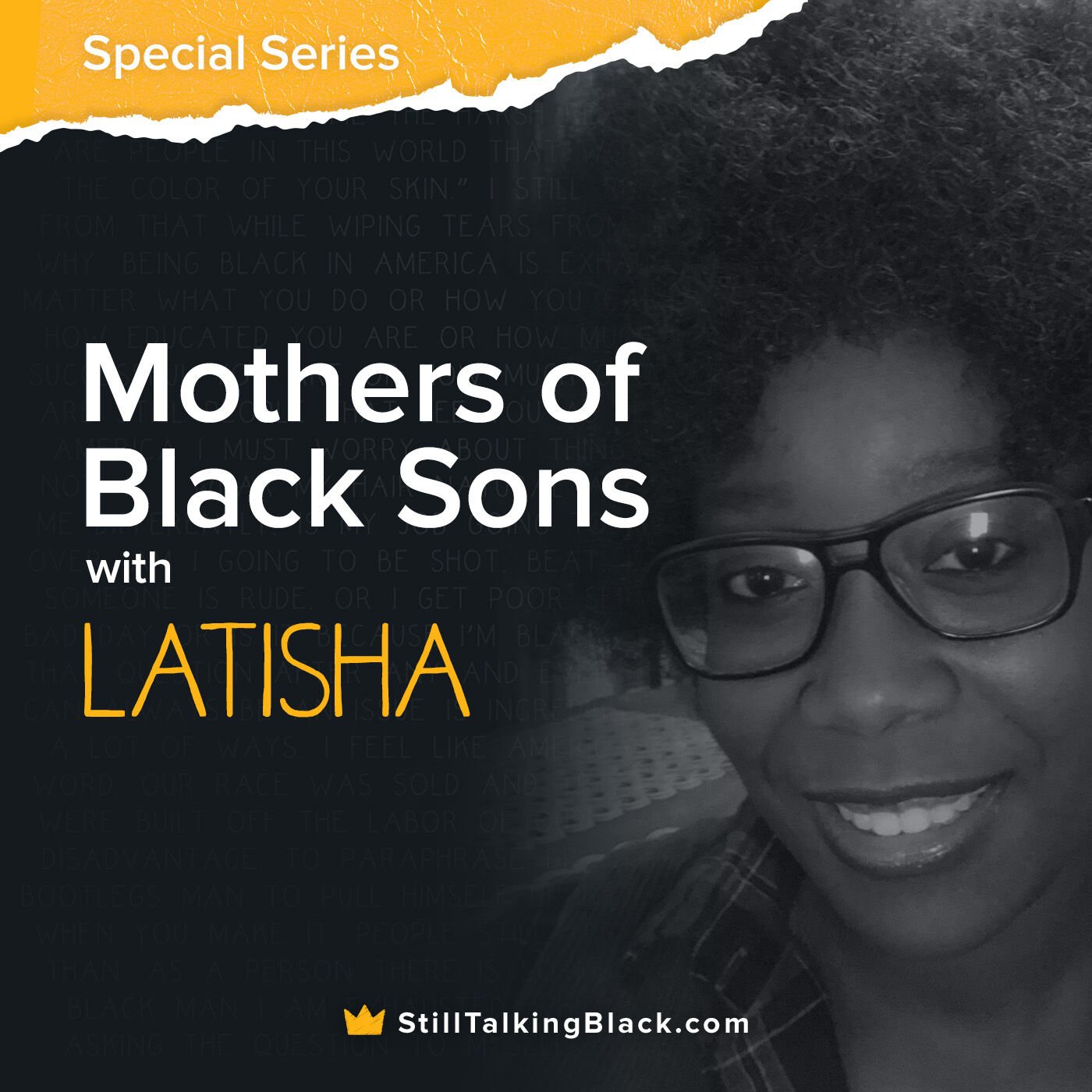
Episode Summary:
This episode is the second of a five-part series that seeks to discover what it's like like raising a Black son in America. This interview is with Latisha, and she has the youngest son of the mothers that were interviewed so her perspective on lessons that's she's taught and plan to teach look slightly different from the other mothers.
Show your Support:
If you like what we're doing here on Still Talking Black, the best way to show your support is by liking, rating, and sharing our content, buying merch from our store at StillTalkingBlack.com/Shop, or donating using the link below. Every little bit helps. Thank you for your continuing support.
About the Interviewee:
Latisha is the mother of a 2-year-old son. Even at that age, she has already started to prepare herself to teach her son how to survive in the world and remind him that he is a king.
Credits:
Host and Producer: Richard Dodds @Doddsism
Show Music: @IAmTheDjBlue
Website: StillTalkingBlack.com
Still Talking Black is a production of Crowned Culture Media LLC. All rights reserved.
Support the show (https://www.buymeacoffee.com/CrownedCulture)
Episode Transcript
Richard Dodds 0:00
Coming up later in the episode,
Latisha 0:02
I had to tell them that I already had to plan to have that conversation with my son of what he has to do with the cops or something. If you get pulled over the cops, what do you have to say just so you can make it home safely. I’m like, who had questions and I was just like, you will never have to give your son that conversation. that’s inherent in my mind that oh, one day, we got to have this conversation of what to do with the cops. It’s unfortunate. But at this point, I want to do everything in my power to make sure my son comes home safely every night.
Richard Dodds 0:34
This is still talking black, the show about giving perspectives to issues that minorities face every day. I’m your host Richard dyes. Today’s episode is part two of a five part series where I talk to mothers of Black Sons talk about some of the things they have to go through when raising a black son into a man. Last episode, we talked to Kendra and she talked about some of the additional issues that she had raising her son because he’s biracial. This episode, we’re going to be talking to Leticia who has a younger son. As we go throughout this series, you will see that a lot of the mothers perspective are different, but they still have to deal with some of the same issues and some of them have unique issues depending on how old their child is and the background that they come from. So again, I want to say thank you to all of the mothers part three will be coming out Friday, part four next Monday and the finale part five will come out that following Friday. If you like what we’re doing here are still talking black, the best way to show your support by liking, reading and sharing our content, buying merch from our store at still talking black.com forward slash shop or donating using the link in the show description. Every little bit helps. Thank you for your continuous support.
Latisha 1:54
Hi, my name is Leticia and my son is two years old.
Richard Dodds 1:59
So how did you feel when you found out you were having a boy? Oh, when
Latisha 2:03
I when I was having a boy Alex excited. And it was my first pregnancy too. So I was excited and scared. But a little bit overwhelmed because I knew he would have definitely have some issues growing through his life that most people wouldn’t have. So is you have all those feelings upfront and is definitely overwhelming. But overall excitement though. So that was a good
Richard Dodds 2:27
what is it like being a mother of a sigh scary because they’re
Latisha 2:31
you know, they’re they’re naturally dairy right? So you know, it their nature is very destructive to so like so that’s scary too, because he’s always climbing up on things, especially at this age and everything. And just knowing that, you know, when they when he’s going to be a man, a black man, so it’s just scary overall. And you have to keep that in mind when you’re trying to raise a little boy into a black band too. You have to always keep be conscious of that. So yeah, is
Richard Dodds 3:01
it is it destructive? Or is it as adventurous and fearless?
Latisha 3:05
Sure, we can say that. You know sometimes I just like he does don’t purpose like Oh, I’m just gonna take this crayon and mark up this whole wall with it. Oh when I gave him a big sheet of paper to mark on the yet what a paper is not
Richard Dodds 3:26
as big as the wall though to be fair,
Latisha 3:28
true. A bigger canvas, I guess. I need to get my easel so you can do
Richard Dodds 3:39
upright stuff just trying to express himself. That’s it?
Latisha 3:42
Yeah. Okay. I will give you that.
Richard Dodds 3:48
So how would you explain the connection between you and your side?
Latisha 3:52
Awesome. Like, we have a very personal you know, we’re very in tune with each other. And, you know, I understand what he’s what he’s feeling and what he needs without him, you know, obviously broadcasting it. Like I know, when he’s using an app. I know when he’s hungry. I know, when he you know, he’s having a bad day. So I would say very in tune in where we’re like, we’re definitely aware, and I think he’s aware of me to because, you know, sometimes you just come up to give me a hug. I’m like, Oh, I needed that. You know, so it is very, you know, unconsciously things like that. So
Richard Dodds 4:27
that makes total sense. So, what are some important lessons that you taught or planning teachers on?
Latisha 4:34
What sense is it to, I guess my, I’ll be planning, but I like I wanted to teach him to be a strong individual, and be safe as far as when he leaves out the house, Right? but also be aware that you are a powerful being and you can do anything if you set your mind to it and you don’t have to be afraid of anyone. But you just have to do it in the right way. So and I went I want to make sure that he understands that he is a little King, and I want him to conduct himself accordingly. So those are all the things I want to teach my son like we do, like, we have this one affirmations that we do, like, we go to bed, we do the I am like, I am great, I am beautiful, I am smart. So I want him to understand I get in my early that he is amazing the way he is. And I don’t know what else to think make him think otherwise. And then the last one is you of course is I am a king. So he screams that part. So like, and I make sure that’s the excitement on that part two that we both screen that part. So like, so that’s what I want to teach you I want to date he is perfectly made just the way he is.
Richard Dodds 5:46
That’s a beautiful lesson what what does I am a king mean to you when he says it? When he says
Latisha 5:51
it? I feel like the fact that he gets excited to say it at such a young age as to I feel like he already recognized the importance of it. And so he seemed like you know, we have a little book so he knows what it can look like to have one of the nice little feral things that he like, you know, so here are you putting together like, okay, that’s the king, right? If you could open a book and say that’s the king. So I felt like he’s putting two and two together already at such young age that he’s gonna grow up with such a great understanding that most little black man little black boys don’t get to grow up, especially if they have to have absent father or something. So to have that connection early is amazing. So you recognize it, all of his king books are his kings are black pharaohs,
Richard Dodds 6:35
I was thinking until Black Panther came out we really didn’t have many great examples of black kings, on media, on television, maybe in books, but not not on television.
Latisha 6:47
Absolutely. Right. So that’s we made sure we had those type of books, and make sure he has the imagery and the representation that he needs in all his books, like Yeah, sure, he has probably like one or two books, little white kids or something. But most of his books have black people. So I have very immersed in the black culture, I want to be proud of being who he is. And I never use the word adult though his little shy because he wakes up happy. And I want to make sure you can see use that throughout his life to wake up and RayRay for the world. It’d be happy to be in it though.
Richard Dodds 7:16
So that’s beautiful. And it’s great now that we have books and and media that represent us that that people look like us. And we don’t always have to have someone. We’re not reading stories about people that don’t always look like us. Yes,
Latisha 7:33
I do. I am happy about that. And a lot of people are getting, you know, a lot of more stuff is like publications coming up with like people in it. And a lot of black authors are, you know, putting out these types of books to help us understand our history and everything. So I’m off board, like any ones I come across on saving on my car, and you know, one big cart cart and have was shipped to the house though,
Richard Dodds 7:56
are there any lessons that you’ve taught our planet teach your son that naam black mothers don’t have to teach your kids?
Latisha 8:05
Absolutely, like, like, it’s crazy, because I had to actually go through this when we when the whole like chores, floor thing happened at work. And so they had this, this whole big hole cut, you know, company wide departmental wide array of like, unconscious and stuff and how you know how to be relatable to black people, which is whole big reveal. And it was funny, and it was it was weird that I was actually like, Oh, you want to share your experience? And I’m just like, Oh, really? Okay, but sure. And this is probably like, you know, obviously, it was probably just for a couple of months, like eight months or something. And so I was like, I had to tell them that I already had to plan to have that conversation with my son of what he has to do with the cops or something to get pulled over the cops. Like, what do you have to say just so you can make it home safely? So and, and they were just like what it was, you know, there was you know, someone who had questions, and I was just like, you will never have to give your son that conversation. But I already know in my mind that I already had to give it to him. Like we that’s inherent in my mind that oh, one day, we got to have this conversation of what to do with the cops. What to do when you’re at a white location or you’re surrounded by white people, like you have to you have to have those conversations with them early or your son is not gonna make it home that night or you know, it’s unfortunate, but at this point, I want to do everything in my power to make sure my son comes home safely every night
Richard Dodds 9:35
thinking thinking about some of that stuff going into all of the tragedies in the way that black men are treated in America. Do those tragedies hit you any harder now that you have a black son that you’re raising to be a black man?
Latisha 9:49
Absolutely. Like I find myself crying like when I see stuff on the news, like especially when it comes like when I see you know, little kids being hurt or neglected or I want to start with the cops have put over these 10 year old boys put the guns out. And it was like walking home from the park like, those stories like actually make me cry. Like I used to be sad before like, oh my god, this is terrible. But once you have a son, it’s like, it’s totally, because that could be your kid, right? And so like, I find myself a tears, oh, after certain stories like, oh my gosh, this is just terrible. Because any moment, this could be my kid, right? If he walks to the store, or he’s going to the local playground, like when he gets out, this could be my kid. So it definitely hits a lot harder. Once you have a sign a black, a black sort of brush your
Richard Dodds 10:38
painting by like representation we’ve kind of talked about a little bit earlier, the sad thing is so many times the representation that we’ve seen in media is that it’s these tragic stories, we see ourselves in these tragic news stories. But we’re just now being able to see ourselves in these uplifting superhero movies and different kinds of productions. As technology changes. It’s just I think media has such a strong tie into how people tend to see themselves and if all we see ourselves as headlines, makes it really hard to have a lot of hope. And I’m really glad that you get to record your song in a world that is now being at least more open where you can see things other than the bad things.
Latisha 11:19
Yes. And as a parent, you have to be conscious in my like my for what your kid watches, because it’s so dire, right? Like, you have to make sure you’re feeding your child the right diet. And he doesn’t want like I made sure like whatever he watches on TV or something is always some type of representation. And so like, again, he likes Coca Cola, but that’s like, whatever. But like, you know, and I make sure like, if I’m had to be watching something, if he comes in or something that is not right, or something, I change it, or like I’m always aware of what his eyes can see, especially at two, but I’m pretty sure it’s like when you’re like your kid is older, you have to definitely be aware of what they’re bringing into their mind their spirit, because all that affects them. So they might not say it to you, but they’ve got to fill it on the inside. So you have to be mindful of the things you’re feeding your kids as far as media books, literature, like books, magazines, music, all that is feeding into their soul you have to be mined for that. So
Richard Dodds 12:18
thinking about how some parents especially it’s like some black parents tend to raise their kids to be athletes and and different, you know, football player, basketball player, something of that nature. Are you mindful to make sure that you are showing your son that he can be anything he wants to be and not just those things?
Latisha 12:38
Absolutely cuz me I am a brain I am not an athletic person. Like and you know, and I want him to be able to be be aware that you can use your mind for great things like you can be successful using your mind you don’t have to be an athlete you don’t have to dribble a ball or you know run down no field or anything like that you can be successful at doing everything you want. We just use your mind because that’s what I’m pushing that’s why I push the books and everything like I want him to be able to use as my hey, if he’s a great athlete come you know when he gets into that, that’s amazing. But he will be a straight A student and in all these extracurriculars and all this football or basketball or whatever team that will be an added bonus that won’t be the highlight
Richard Dodds 13:23
and I think is great when you can’t have that position. It’s always great when your kid excels in something and you see people’s kids excelling in something but making sure that that’s not the only focus is is I think it’s just as important just because that is where you see us not being owners all the time when I was growing up we weren’t on in basketball teams we weren’t we weren’t even like coaches a lot of times we weren’t general managers we were just players and that’s it. So we can see like us being players and then these white guys on and on in in coaching and telling us what to do. So yeah, I kind of got that feeling from you from talking to you that yeah, I’m gonna instill that he can be a canine could be a king anything and not just one thing and that was two things I just got that sense
Latisha 14:08
for me Yes, absolutely. I don’t want I don’t want anyone to put myself in a box at all because I don’t I don’t like to be put in the box I don’t I don’t want people to be expecting oh she should be doing this or they should be doing that No. I want him to be able to think outside the box venture outside the box create a new box you know so and that’s what I’m instilling into him so that’s why he’s like learning sign language like Oh, most people it was kiss oh no eating my sandwich but he knows a lot so you know just just just you know, getting him used to things that can prepare him to be overall outside the box thinker.
Richard Dodds 14:44
Sounds like you’re doing a good job
Latisha 14:52
only have one so I’m curious to see you there was about three For five kids was up there.
Richard Dodds 15:03
How was experience of being a co parent?
Latisha 15:07
I mean, that’s a challenges because you have one person who’s the primary and then, you know, even when they say like, co parenting like, it’s really not co parenting, because there’s not 5050 down or write down, you know, straight down. It’s not it’s it’s like, it’s really I’m the parent a year, part time parent your time co parenting is kind of because yeah, you’re you’re like, co parents. I mean, it’s like, okay, I take him to school, you picking them up? You feed them dinner, you know, Oh, I’m getting ready for a bath or so. That’s co parenting. Not. Oh, okay. You probably get them on the weekends. Okay, cool. You probably get like two evenings a week. Okay, that’s great. That’s but that’s not co parenting. That’s not equal co parenting is not, it’s not. And so that’s why I don’t like the term of cope. Because it’s really not. But with my situation, like, you know, he’s he, I’m definitely the primary and he you know, he does all the mail things right takes to get his hair cut, you know, picks them up when I need him to pick them up, take him to the dentist, cuz I don’t do that, because I’m not trying to do that. So he does stuff like that. So it helped like for us it works because he it fits me. Right? So but hey, other people, I whatever works for you guys. Loans, your child have some type of relationship with the parent and you both respected to the boundaries of space. And hey, whatever how you how you see it?
Richard Dodds 16:45
Is it is it a relief, at least having a situation to where he is able to have a relationship with his father, and you do not have to teach him how to be a man in certain aspects.
Latisha 16:57
Because right now, we’re doing that whole potty trainer thing. And I’m just like, how the heck I’m supposed to do that? Because I can’t show him what to do on that part where you got to stand in front of him. Like, yeah, you know, the stages are like, teach him how to sit down first, and you have to kind of stand up. So I’m dreading the host. And I’m like, oh, yeah, take over this. Because I can’t do that I can do I can teach him to sit down. But once that next phase patronymic come, it’s gonna be like, yeah, you need to come on, come on with this because I can’t do it. He needs to see you do it. I can’t do it. So I am definitely just with the pilot training like Yes, but But yeah, black the like, just even with without him, like without his father or his father being around, just making sure he’s around other males period, good meals, like he’s not around the craziness. But males that I admire and stuff just so he could see like, oh, yeah, that’s, that’s a man right there. Like, he’s so big and strong. And his voice is deep. And, you know, just just, you know, as a two year, that’s those things you kind of look at, right? So it’s not a woman, right? So just making sure that he is connected to his father connects to other males all the time, like he’s not surrounded by me all the time. He’s not surrounded, you know, by women all the time is keeping him surrounded by strong black men in general, is a must. Because I can’t I mean, I can raise a man, but I can’t show them how to be one. Right. So yeah, I had to keep that in mind. Or they could do so much. Right? Yeah,
Richard Dodds 18:25
I think it’s definitely lessons that my mom was able to teach me that my dad couldn’t and vice versa. Yeah. And I think it is important to be able to, because when you have when you have a little human being it’s a little mixture of both, right?
Latisha 18:39
It is it is. Sometimes he does become like, Oh my God, just like your daddy. To like, just his mannerisms. Like, how did you pick up on that? So it’s good. Like, that’s the anticipation we have a key like, oh, the mixture, what makes you want to come out? Like
Richard Dodds 19:05
what is the biggest joy of being a mom,
Latisha 19:08
I think the biggest joy for me of being a mom is waking up to that face, like, like you can have, I can have a bad day. I can just be just out of my mind, like all day, then it all fades away. When I see that little face. I don’t have a day at work, right? But when I go pick him up, he gets in my car. He runs to me just like all my troubles and then washed away, right? Because it’s like, how can you be angry about life when you have this face in front of you? So like I just get that joy because he is a sense of enjoyment, like the ultimate enjoyment. So and I love that lesson. My biggest thing about being a mom is just being able to just see that face all the time. I love it.
Richard Dodds 19:58
That’s awesome. Well That’s so thank you for coming on the show.
Latisha 20:04
Thank you. I’m glad you had me. So I enjoyed it. I love talking about my kids. So,
Richard Dodds 20:09
so easy subject, right. So that’s all I have for this episode. Remember that this is a series and the next part will be coming out this Friday. And then part four and five will be coming out next week, so make sure you stay tuned for those next episodes. Again, thank you everyone for listening. Still talking Black has a crown culture media LLC production. It’s produced by me Richard DODDS. Our theme music was created by the DJ blue, please make sure to rate and subscribe to the show on your favorite podcasting app. You can follow the show on Instagram as still talking black, but until next time, keep talking
Transcribed by https://otter.ai