
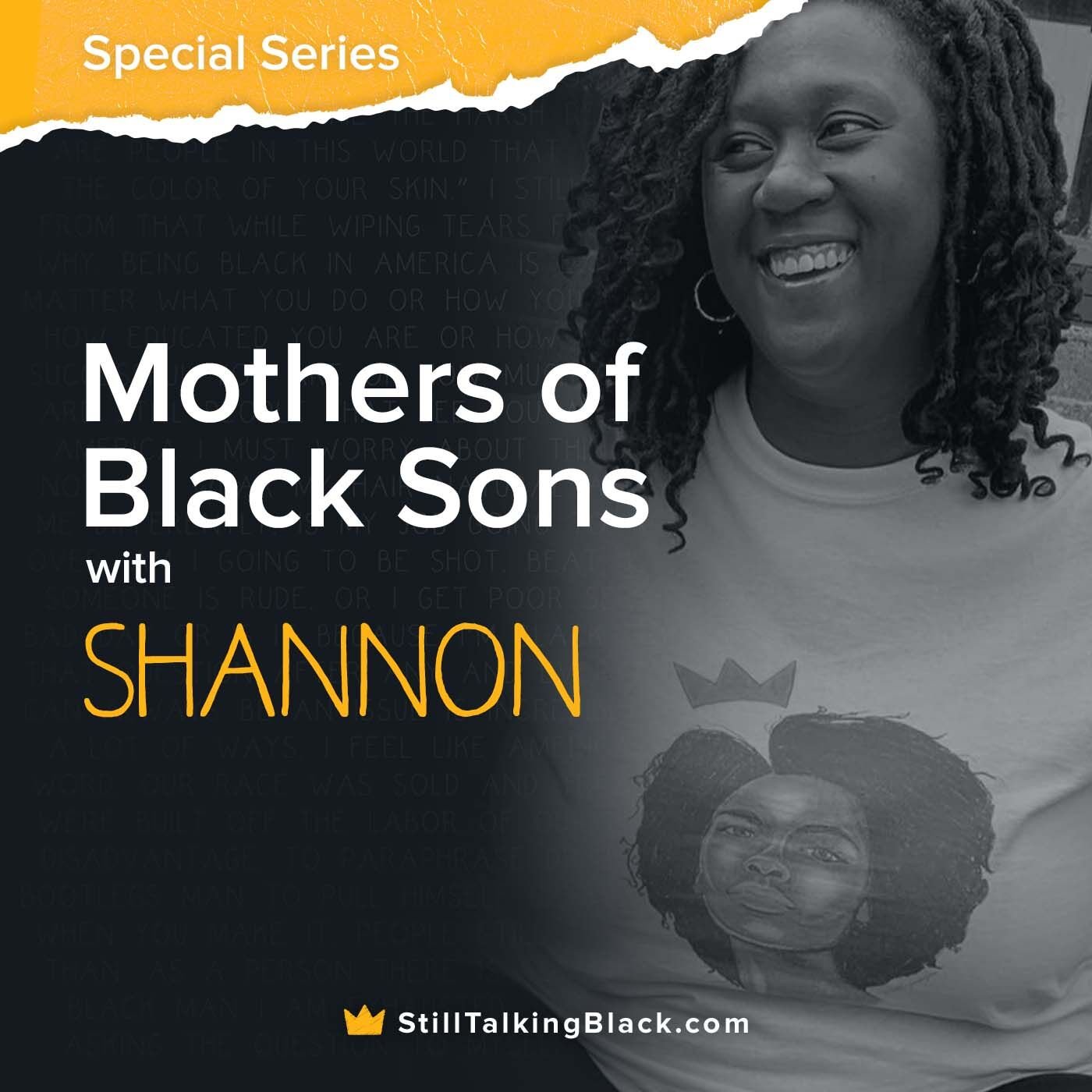
Episode Summary:
This is the third episode in the 5 part series Mother’s of Black Son. Shannon talks about the obstacles she’s encountered and the worries she has raising her son. During our conversation we talk about issues with colorism, watching injustices happening around us, and much more.
Show your Support:
If you like what we’re doing here on Still Talking Black, the best way to show your support is by liking, rating, and sharing our content, buying merch from our store at StillTalkingBlack.com/Shop, or donating using the link below. Every little bit helps. Thank you for your continuing support.
About the Interviewee / Spotlight on Melanin :
Shannon King is a multi-talented creator and podcaster. Shannon, alongside her podcast partner Jared L. White hosts The Not Your Enemy Brand: Speak Out Sessions, where they talk to other creators about issues facing the Black community. You can follow Shannon on Instagram @visionaryccb. You can find the podcast: not-your-enemy-speak-out-sessions.castos.com and the episode featuring Richard here: not-your-enemy-speak-out-sessions.castos.com/episodes/speak-out-sessions-wrichard
Credits:
Host and Producer: Richard Dodds @Doddsism
Show Music: @IAmTheDjBlue
Website: StillTalkingBlack.com
Still Talking Black is a production of Crowned Culture Media LLC. All rights reserved.
Support the show (https://www.buymeacoffee.com/CrownedCulture)
Episode Transcript
Richard Dodds 0:00
Coming up later in the episode
Shannon King 0:02
is a large sense of anxiety in my life because I don’t want nobody to try my son and I also don’t want my son in a situation of danger where he might lose his life at whatever age because age clearly doesn’t matter. I’m in this world when it comes to black men and then being protected. I can’t even explain the emotion and being married to a black man like and understanding that I understand why people don’t want to have kids in this day and age because it is a weighted pressure to be their protector, but also knowing that this world is so messed up that you can’t even do that.
Richard Dodds 0:35
This is still talking black, the show buggy for perspectives, the issues that minorities face every day. I’m your host, Richard Thais. Today’s episode is part three of a five part series where I talk to mothers of blacks on this episode, we’re going to be talking to Shannon King. She was previously on a show on the black creatives episode, and today we’ll be hearing about her and her son. Last episode we talked to Leticia who has a two year old and is trying to make sure that she raises him with confidence and to know that he is a king. The very first episode with Kendra she was dealing with the normal issues along with raising a son that was biracial. So each woman’s perspective has been different. But as you’ll see in this episode, Shannon faces some issues similar to some of the issues that Kendra face but in a different way. It all comes down to colorism, but you’ll hear more about that later. Again, as always, I would like to thank everyone for listening, but also the moms who shared their stories on each and every episode. If you’d like what we’re doing here is still talking black, the best way to show your support by liking, reading and sharing our content, buying merch from our store at still talking black.com forward slash shop, or donating using the link in the show description. Every little bit helps. Thank you for your continuous support.
Shannon King 1:54
My name is Shannon and I have a four year old son.
Richard Dodds 1:58
Alright, Sanders back. It’s good to see you again.
Shannon King 2:02
Good to see you.
Richard Dodds 2:04
So how did you feel when you found out that you were having a boy,
Shannon King 2:07
I was an overwhelming sense of feeling, I’m not gonna lie, I always wanted a boyfriend whenever I decided to have kids, because I have a family full of females. So a little boy was something that I desired. And also I wanted a little boy to come and be the protector of you know, a little sister or siblings under him. But then it was like what everything going on in the world. There was a fear and hesitation of how do I raise a black son in today’s society. So that weight kind of hit me a lot throughout my pregnancy.
Richard Dodds 2:42
So what is it like being the mother of a song?
Shannon King 2:48
Son in general, a lot more energy alive. But I think that for me, and I think it’s any parent is raising someone that you know, is going to be successful in life. But also I want to raise my son to be respectful of women, I want to raise the son to understand communication and how to communicate effectively and not be afraid of his emotions. Which I think is very interesting in a day and age because a lot of the old school will say like, you know, boys don’t cry. And so trying to navigate how I want to parent versus how I was parented because that comes into play as well, especially with boys because I don’t want that, you know, crazy masculine stuff where he can’t understand how to communicate effectively.
Richard Dodds 3:36
I think a lot of the stuff that you said is lessons that I learned from my mom and things that I can remember her teaching me as a young child, like don’t touch woman here, don’t do this don’t. It’s stuff that was very valuable that I don’t know, even me as a dad will be able to think about that so readily to be able to teach my son so so you kind of talked about this a little bit in our last one. But what are some important lessons that you’ve taught? Are you playing the teacher side?
Shannon King 4:04
The biggest lesson right now and I think it started just when he was able to communicate more, is it’s okay to be upset and frustrated. But it’s what you do with that frustration that really matters. So it’s really teaching him how to feel but then how to communicate his feelings. And sometimes I do have to stop myself because, you know, I’m human, and I’m an adult, and I don’t What are you? What are you crying for? What’s the right you know what I mean? And getting annoyed but not understanding that he is really just feeling all his feelings. So that is one important lesson that I’m trying to teach him. Also no shade, but I’m also teaching him how to apologize.
Richard Dodds 4:43
Because no, say hi.
Shannon King 4:47
You know, but not even honestly for me too. Like I struggled like I’m not I’m not wrong and you know, and it’s hard, harder when you get older, to be able to humble yourself. So apologize if you did something wrong. So Now it’s kind of like, I want you to be comfortable to apologize when you know you did something wrong, because I feel like that foundation now will help him in the future, you know, male or female. But you know, I tend to be shady with that. No,
Richard Dodds 5:13
you think you think males have a harder time apologizing? Yes.
Shannon King 5:17
But they also have a hard time with emotions and communicating. So all that is goes to show I want him to be a man that doesn’t have any issue with any of that stuff growing up,
Richard Dodds 5:28
are some of the lessons that you are teaching your son as a mother, lessons that you wish that other men that you have dated their mothers had taught them?
Shannon King 5:39
Yes, and no, I don’t necessarily look at that I look at you know, the generations before us, it was different. You know, you’re just you’re providing, you know, and you’re just trying to make it through and have your kid have a better opportunity. So I don’t necessarily know if I would have saved my experiences is just even with my husband. And, you know, we’ve talked, we talked about how he wanted to raise our son, but just areas that he struggled with. And then also the interactions with men, not romantically, but just seeing, you know, men in the workplace, men with my friends, you know what I mean? And to see, I’m like, why don’t you just say like that, you know what I mean, I want my son to be able to communicate, not offending women not being, you know, passive aggressive, I want him to be able to conduct conduct himself in a way that everyone’s gonna know how he feels and who he is as a man. But also he needs to respect the respect, respectful, other people’s, you know, feelings and emotions, etc. So I don’t it’s kind of a mixture of, of experiences.
Richard Dodds 6:41
Are there any different lessons that you’ve taught your your son that you think that other non black moms haven’t had to teach their sons?
Shannon King 6:49
Yeah. I would. I hate to say that, because it like, is earth shattering to a mother. But yeah, I think I talked about this last time I was on but just think he was about two or three. And we had like a, it was like a gym class for, you know, kids, where they can play, run and meet other kids. And there was, you know, this family and this child, who was just actively avoiding him. And it was to the point where it became blatantly obvious. He was too rough for him. And the mom was very much making it known me as an adult, I can pick up on it, but my son did not pick up on it, and was just like, Why doesn’t he want to play with me? So sometimes, you know, the conversation is, you’re, you’re beautiful. You know, you’re great, you’re fun to play with, but not everybody’s gonna want to play with you. You know, even kids don’t see color. Kids don’t see skin color. But my son knows that he’s black. He knows that his skin is brown. He knows that others are not all going to be the same skin color as him and he doesn’t mind that. But it’s just understanding that his skin is brown. He’s beautiful. So that someone if someone is not in my presence said something that he understands he’s a king, he’s brown skin, he’s beautiful. He’s handsome, all those things? Yeah, I started that foundation early. And then when that experience happened, just him understanding everyone’s not going to be your friend. Everyone’s not gonna want to play with you. And that’s okay. Play with somebody else that wants to
Richard Dodds 8:20
do you think is that kids don’t see color, our kids aren’t bothered by color until they hit a certain age? Well,
Shannon King 8:27
I think it’s you got to know your colors first. I think it’s a mixture of both. I think that they’re they don’t care because all they want to do is play everybody’s their friend or something. So and that’s, I think the most, the hardest part of being a mom of the black son is like, you just want to keep their joy and their purity. And the world just wasn’t, doesn’t allow that. So for me, it’s almost like he doesn’t care. And he just wants to play and be friends with everybody. He will talk to strangers for hours. And sometimes I’m like, let one person be rude to my child. But I think every kid like that, they just have that joy. They don’t have the complex of race and all that tension. They don’t have that history. society teaches us that so I want to teach my son, you know, love everybody, but you’re going to be treated differently.
Richard Dodds 9:16
Oh, that was such a good tight chatter, preserve that innocence as long as you can. Think about that. The last episode I released was about colorism and the story that I told at the beginning and I went on Twitter. And it was a story about my niece and my niece wanting to be white so that she could be beautiful, and she didn’t even understand that palac light skinned kids were still black and so much division and you wonder, like at that age, like Where Where did you learn that? From? Where did where did that come from?
Shannon King 9:50
It. It’s taught, I feel like it’s taught and sometimes I think that we in the black society are the ones that teach that, you know, even you know, I’ll talk about oh, My son, my, my husband is light skinned I am dark skin. My son is like skin light skin color, if you’re talking about definitions that we’ve created, and even some of the comments of like, Hey, I wonder whose hair he’s gonna get? Or I wonder, you know what I’m saying? Like, How dark is he gonna be like, whose complexion is he gonna have? Again, my son is beautiful. I don’t care what complexion he was. He’s mine. I birthed him. But it’s unfortunate, because a lot of the conversations that the millennials are having are about colorism and how they felt growing up, but I see it I have nieces that are in school. It’s literally I’m like, if y’all didn’t like it, you’re raising your children to see the same thing where there’s some high end of beauty if you have fair skin and your lighter brown skin. Brown is brown. There’s there’s different shades of brown, but yours it doesn’t define you as a black person. Just it should be beautiful across the board. So I think, to me, we’re doing a terrible job of releasing and getting rid of the colorism even though we know we are fully aware that it exists. Yeah, I you know, I don’t want my son to have to ever question his skin color. My niece does it right now. She her friends call her Blackie. I’m like y’all are 12. Like, where do you get this from? And she’s not as dark as me. So it’s sad. I know, I’m not raising my son like that. But it still exists. And we’re doing a really poor job of kind of getting rid of this whole colorism amongst the black community.
Richard Dodds 11:30
I think it’s something and I’ve probably I’ve probably said this a bunch of times at this point. But I’ve always said I think I said on your show, I’ve always learned more from what my parents did and how they acted, then what they said. So I wonder how many times that us and the media that we are letting our children consume is influencing their behavior and their ideology around color. Right? Because they’re a little sponges, they pick up on every little thing, you don’t have to say something, they will pick it up.
Shannon King 12:03
Exactly. So that’s I’m I, I will say us and as an entity, as a whole black community have done, you know, the media is going to do it. I feel like you got to just position your child to understand that the media is not 100% reflection of the black community. But I think in our homes and our family reunions, and all that other stuff where we’re talking about, you know, if a black person gets a tan, oh, your blood like it black, but and I just think we need to start living that more than something else. Because it’s really damaging generations upon generations. And it really is a toxic mindset that I think we got to just do a better job of being cognizant of,
Richard Dodds 12:40
yeah, plastivision in our own community, and is never a good thing, especially a community that’s already behind, when it comes to a lot of things and advantages that other Americans enjoy. Right? Exactly. With America being the way that it is towards black man, what are some ways you’re preparing your son to be a man,
Shannon King 12:59
he’s four. So I don’t know if I have the answer to that. I’m not gonna lie to you. So when I was pregnant, there was a lot of things happening at that point in time. And I remember like, hysterically crying and saying a prayer to God, like I just, I just want to protect my son because there’s overwhelming just as a mom sensation to just be that Mama Bear protector. And I honestly know, just living in this world, I’m not going to be with him every single day, and I’m not going to be able to shield him and protect him from everything. And being for like I said, my goal is to just keep him as pure as possible. I don’t want to make him ignorant. So in the same breath, so for me, it’s just the foundation that hey, everybody’s not gonna like you, you know, respect authority, but also stand up for yourself. And when he gets to the ages of he’s gonna be out more than me, we’ll have conversations about you know, police and more active racism, like direct racism, because I think there’s a lot of different nuances to that word. But I’m just like I said, I’m trying to keep him as pure because he really is a sweetest boy. And it makes me so happy that he just loves on everybody and sweet to everybody. I would like to keep him that way. And I would imagine that most parents will want to keep their child that way for as long as possible. But the conversations have kind of started to happen of like, you know, not everyone’s gonna like you. It’s okay if you know if someone was means them. That’s not nice. We know that’s not nice. And you don’t do that. But you can’t always control other people’s actions. The response shouldn’t always be anger. Sometimes you got to use your words or think, you know, those are the small lessons because again, he’s just for but there hasn’t been like a detailed in depth of like what to deal with when you are directly attacked by a racist person, a racist act or you know when authority takes you no advantage of their authority. We have not gotten there yet.
Richard Dodds 14:52
I know in general was hard to watch the in justices that happen to our people. But now that you have your son Is it harder to see the things that are happening? The black man? Like, it’s so many numerous stories? Like, is it harder to watch that? Does that hit a little bit harder? Does it hurt about the same?
Shannon King 15:12
No, I would say it hits harder. It’s a lot harder. And it for me, is a large sense of anxiety in my life, because I don’t want nobody to try my son. And I also don’t want my son in a situation of danger where he might lose his life at whatever age because age clearly doesn’t matter. Um, in this world, when it comes to black men, and then being protected, I can’t even explain the emotion and be married to a black man like and understanding that, I understand that people don’t want to have kids in this day and age because it is a weighted pressure to be their protector, but also knowing that this world is so messed up, that you can’t even do that. So just seeing my husband, you know, when George floored and just the anger and the rage and the pain, and then you look at your little son that you want to protect and understand that like, it might come a day that I can’t do that. And I would never wish that pain upon any mother to lose your child in such a way that could have been avoided if there there was a little bit less hate and ignorance,
Richard Dodds 16:18
as definitely it definitely is hard to watch. And I can only imagine having a son. And you see on television, like, can you imagine being a young boy, I don’t I don’t remember the first thing I remember as a young boy seeing as Rodney King, that was the first time I’ve ever seen something like that. So graphic, you know, your you heard about as a kid, but you never got to really see it. But that was the first time you could visually see it, what media being aware that it is and you like, wow, those people who are having stuff happened looks just like me, and just all the other different things wrong for incarceration. And you got to worry about the police. And depending on how you raise your son, or your child period, you have to worry about the neighborhoods that you’re in, and don’t fall into the wrong crowds, and then have to worry about other aspects of your child becoming someone that you don’t want them to become.
Shannon King 17:15
Yeah, I mean, I don’t know, I’ve been watching a lot of red tape, we’ll talk and I understand that I was just a vessel to get my child here. So he’s going to turn out to be whatever, like, you know, whatever he’s destined to be, but my control is just providing him a foundation so that he’s a good human being. But you know, like I said, you can’t protect them from everything. And you know, they’re going to make choices that you might not agree with, but I just would like him to be a decent person. And safe from any harm. But like, you know, I was in a thank God he was in the car. I mean, that’s like a prayer. I say thank you. I was caught in like a Trump. I don’t know, what was it like a hate parade and a 12 year old flipped me off. I’m like, you’re teaching a 12 year old, a 12 year old to spew hate and flick off and have such hatred for people that you didn’t even I was in a car, you wouldn’t know anything about me. And so even that, that took me a week to like, not want I had to drive with somebody for a week. But I’m glad my son didn’t see that. Because I don’t I can’t imagine having to explain that to him. Because what does that teach him that a child can pick up middle finger and that’s okay. So again, it can’t shelter them everything. And I hope that I’m giving him the tools and the foundation that he can function in life, regardless of whatever is thrown at him.
Richard Dodds 18:37
So Shannon, you’re married? Do you feel any relief? Having a partner that can help you and raising and teaching your son certain lessons?
Shannon King 18:47
Yes. 100% Yes, um, you know, I know a lot of single mothers and, like, I’m married with a partner and I struggle, so to not have the money. Shout out to all the single mothers out there because it’s hard to do. So I can appreciate having somebody that if I am burnt out and have no patience for my child, that there’s someone to be able to take, take the reins and take the head, you know what I mean? And also, I married an amazing man. So I want my son to see that I want my son to see love. I want my son to see how his father treats his mother in a positive light. You know what love can look like when he is old enough and wants to marry get married, or whatever the case may be. So I don’t take that for granted. I’m not one of those people. Like I understand. I see it all the time. And I’m like, as a mother, I can’t imagine doing it for myself, but I know a lot of mothers do it. And it’s hard. It’s hard either way, but shout out to my husband.
Richard Dodds 19:49
What is the biggest joy of being a mom?
Shannon King 19:51
The biggest joy? Hmm, I don’t say I hate saying this, but it’s really like how I feel. But it’s just like the opportunity to create Something that could be bigger than me. So, you know, I births you know, a human being I birthed a life and I’m helping. And it’s the hardest job I’ve ever had. I am creating, and you know, providing the foundation and tools for someone to live. And so God willing, surpass me and carry on my legacy. So I think the greatest joy is being able to like burst something, something into the world that is gonna just go beyond anything that I’ve done, you know, and have, like, everything that I’m providing him with the foundations and the communication and love and all the things that I’m teaching him to go out and be a force in the world.
Richard Dodds 20:39
That’s beautiful. That is beautiful. Well, Shana, thank you for coming on the show again. As
Shannon King 20:47
always such a pleasure and this was a great conversation.
Richard Dodds 20:51
That’s all I have for this episode. But before you go, I like to put a little spotlight on melanin spotlight on melanin as a part of the show where I like to spotlight a creator, influencer artists, business owner or activist of color. Today I would actually like to spotlight Shannon. Shannon is an entrepreneur she does pretty much everything. She’s a realtor, and she’s also a podcaster Oh her podcast not your enemy speakout session her and her co host Jared cover a number of issues affecting the black community. Make sure you go follow Shannon you can follow her at visionary CCB and as Vi es IO in a dry CC be links are in the show notes. So again, thanks everyone for listening. It’s still talking black as a crown culture media LLC productions. It is produced by me, Richard our music was created by the DJ blue please make sure to rate and subscribe to the show on your favorite podcasting app. You can follow the show on Instagram and at still talking black. But until next time, keep talking
Transcribed by https://otter.ai