
Episode Summary:
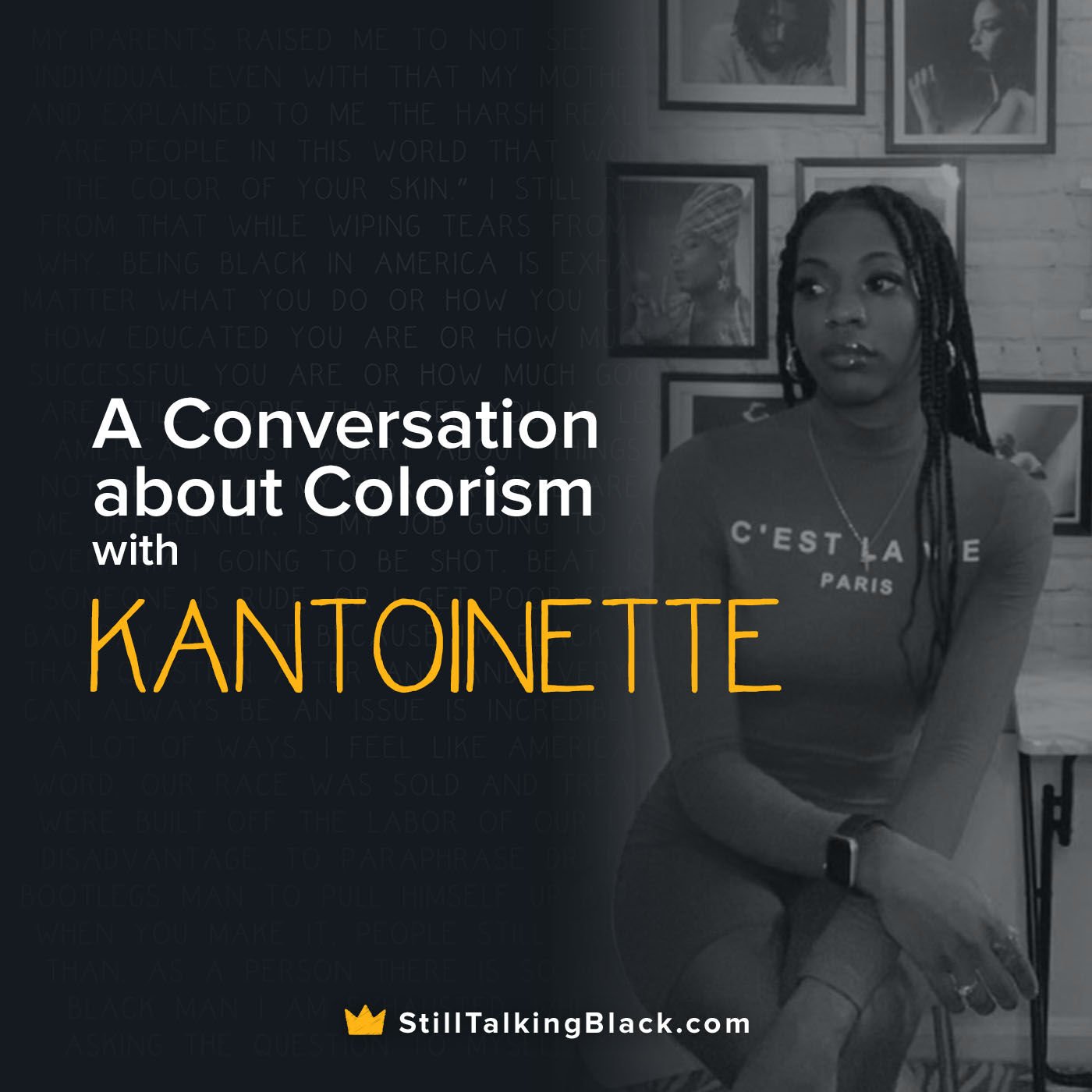
This episode is all about colorism. I share a story about my niece dealing with colorism that really broke my heart. My guest, Kantoinette the Blogger, and I talk about it from many different angles including colorism within our own communities.
Show your Support:
If you like what we’re doing here on Still Talking Black, the best way to show your support is by liking, rating, and sharing our content, buying merch from our store at StillTalkingBlack.com/Shop, or donating using the link below. Every little bit helps. Thank you for your continuing support.
About the Interviewee:
Kantoinette the Blogger, as you may guess by her name is a blogger, but is most known for her podcast LBF Podcast, which stands for Let’s Build Futures. Through her podcast and blog, she takes on many issues that make you not only take a different look at the world, but also yourself. She is currently working on a new business venture in creating one-of-a-kind dates. You can follow Kantoinette on Instagram @Kantoinette_theBlogger and her podcast @Lets_Build_Futures. You can read her blogs at LetsBuildFutures.com. You can listen to her podcast on Apple Podcast or wherever you listen to podcasts.
Spotlight on Melanin:
This episode’s Spotlight on Melanin is Maraj Virtuoso. Maraj is a musician that plays the violin and also sings. Her single Gray Matter puts her beautiful vocals on display. She is also an avid shoe connoisseur that you can often find selling rare kicks on her Instagram. You can listen to Gray Matter on Spotify and Apple Music, and you can see where she’s performing or what shoes she’s selling on her Instagram account @marajvirtuoso_.
References from the Episode:
Credits:
Host and Producer: Richard Dodds @Doddsism
Show Music: @IAmTheDjBlue
Episode Transcript
Transcribed by https://otter.ai
Richard Dodds 0:00
Coming up later in the episode,
Kantoinette 0:02
Specifically, with the music videos, I remember watching you like it and everything and I’m just like, it’s like this I am chocolate. Does that mean that I’m not valuable because these men are saying it every other lyric that they desire women who look this way, you have to have a very strong sense of yourself and sense of confidence to combat that when you’re growing up in an atmosphere that is telling you that you’re not valuable because of not only the color of your skin, but the shade of it.
Richard Dodds 0:34
This is still talking black, a show about giving perspectives issues that minorities face every day. I’m your host, Richard. Today’s episode is all about colorism. Later on in the episode, I’m going to have a fellow podcaster and blogger come on and we’re going to discuss some things about colorism because this is something I really touches me. My niece told me she wanted to be white so that she could be beautiful. For her she equated having lighter skin with beauty. I must admit it was hard to hold back tears. While telling her she was beautiful. Just the way she is talking more to her reveal that it wasn’t white she wanted to be. It was lighter. She equated all the fair skinned black kids in their class to being white. I think more than anything, she just wanted to be like everyone else. I let her know that her beautiful brown skin. Her puffy Afro made her unique and that there is beauty and being yourself. There is no one else like you in the world. So always remember that you’re enough and that you are beautiful. So what is colorism? dictionary.com describes colorism as differential treatment based on skin color, especially favoritism towards those with a lighter skin tone, and mistreatment or exclusion of those with a darker skin tone, typically among those of the same racial group or ethnicity. So this is something that affects the black community, inside and out. We even treat each other differently inside of our own community sometimes, and there’s something that we really need to be aware of. It’s always easy to find something that makes us different. If you divide an enemy, you can have them fight themselves. And you’ve already won the battle, colorism caused us to focus on the things that make us different instead of the things that make us the same. We are all unique individuals with different goals and motivations. But we are still just one people inside and outside of ethnic group, you can find commonalities. But still, every member of each group is unique. Let’s take time to embrace our singular uniqueness and the uniqueness of our fellow persons understanding that we have differences in and out of our socio economic and cultural groups. But regardless of that, we have much more in common. If you like what we’re doing here, still talking black, the best way to show your support is by liking writing and sharing content buying merch from our store, still talking Black Forest slash shop, or donating using the link in the show description. A little bit helps. Thank you for your continuous support.
Kantoinette 3:17
Hey, I am Kantoinette of lbf podcast and on my show. We just talk about all kinds of things. We have the hard conversation we meet ourselves. We build from there and I’m just so happy to be here on this show with Rick
Richard Dodds 3:32
hey did you did you drop the the blogger part of your name?
Kantoinette 3:38
Ah, okay, Antoinette, though blogger, I do have a blog. Allegedly. Let’s build features that calm if you want to read any of my blog posts, I have blog posts about finances life experiences, like you know depression and you know quarterlife crisis, all that kind of stuff is up there. So go check that out.
Richard Dodds 3:59
Quarter life, you know, you know, when you say quarter life,
Kantoinette 4:03
I wrote that whenever I was 25 to a quarter life crisis, but it’s always a good read.
Richard Dodds 4:10
So I know that you talked about colorism before on episode, I think you’ve ended a blog post about if I’m not mistaken, right.
Kantoinette 4:19
Not for colorism. I did an episode about it. But I haven’t actually done a blog post about it ever.
Richard Dodds 4:26
And your own words. How would you describe colorism?
Kantoinette 4:29
Ooh, it’s just it’s so complex. Right, colorism when I think of it is just this subset of like any kind of system that works as an oppressive force, right? So racism being the dominating force there and then colorism being underneath it underneath that umbrella. And it’s just one of those things within our community, black community that keeps us against each other or kind of like this hierarchy of how we kind of sometimes look at each other with the prejudices biases and the same thing, the same functions that racism does colorism does. So that’s how I would describe it.
Richard Dodds 5:09
I think the scariest thing about colorism is that it’s one of those things that I feel like the effect of it is seen almost equally inside and outside of the culture. You know, because we have colorism within the culture itself, because we come in so many different shades. Yeah, that’s something that affects us all. I always kind of equate colorism to like pretty privilege,
Kantoinette 5:35
Oh, pretty privileged. But
Richard Dodds 5:38
I mean, like, and honestly, you know, it’s even some movies. When I, when I look back at some movies, I look at the way that now when I look at movies, I look at them differently. So look at the way that people are portray, like in video games and all forms of entertainment because one of the things that I constantly preaches that media is so powerful, and people do not realize how powerful media is. Right? And so I kind of pay attention to the way that black people are depicted in movies. And not only that the skin tone of black people and movies, and a lot of times and certain movies, the darker skinned black person is the evil black person. But the fairest can black person Oh, that’s the hero. That’s the good guy. We like the lighter skin version. I can think of even movies, movies, where the every, whenever there’s a lead black person, that black person is very, very fair. And you know, you get stuff like that, and the stuff that you don’t really always think about consciously. But if you start to look, look at it, you might not even look at your favorite movies the same way anymore.
Kantoinette 6:39
I honestly had this moment the other day, I love my wife and kids like shows like that Jamie Foxx show Martin, like I will put those on repeat and just keep watching them. And I was watching my wife and kids. And I don’t know, it was just one scene, it had all the like leading women in the in the shot. And they all fair skinned. And I was like, oh, like, you know, I knew, you know, it was during a time where colorism in the media and on shows and stuff wasn’t being asked talked about. But it was very just glaringly obvious. Because I’ve had these kinds of conversations. When I was younger, I didn’t notice it. I just knew that I didn’t see myself on screen like I didn’t feel like you know, some of the material was relatable. And so I think another part of what’s really insidious about colorism is the erasure piece, he said the erasure, erasure, right? Think about like the character of storm. I think that’s a good analogy to use is like she in the comic books, even though she’s a fictional character, right? In the comic books, she’s dark skin, like dark, midnight black. Every portrayal of her has been lightened has been portrayed by an actress who is a fair tone. And when these conversations are had within our community is always or not always, but a lot of the tone is what we you should just be grateful that black people are getting represented. And then my response to that is, well, not all black people are being represented. You know, like, if we’re talking about representation matters, and that’s our, that’s what we say when we’re talking to, you know, to racist or to the racist system, then it matters even when we’re talking about colorism. So I don’t know, I think we can talk for hours about colorism, obviously, what has been your experience with it?
Richard Dodds 8:36
You know, it’s something I’ve never really thought too much about. Ever. And like, it’s kind of like one of those things, once you turn the switch on, you can’t turn it back off. And, you know, I have I’m, I guess, I guess I would be considered lighter skinned, I guess. See, like, even that, even, that is something I never really have put that much thought into until I started, you know, dating as an older adult. And I dated some, some, some darker skinned women. And they would make fun of me and they’d be like, Oh, you act on life’s camp, or, you know, your emotions like and they would kind of like equate, like, the color of my skin as as a way of acting as almost, it’s almost like, it’s not racism as almost like a different kind of prejudice is like you automatically see it and I’m like, and you think a certain way of me and the different tones, get different things added on to know, you know, different characteristics. And it’s something that I think it was funnier, and you know, you didn’t think about it as much when you were a lot younger. As a Worldstar as a tire and different things start to change. You start to think about those things a lot more in a different context than you used to. And even try not to perpetuate some of the stereotypical things that that gets it, you know, like, oh, like like scandals or saw that that was like were like a really big thing and meme culture and Black Twitter was like talking about this hot lights can do is watch Drake and it’s hot dogs can do this and it was always something equating to color. And one of the things that I said you can get your enemy to fight it, fight them between themselves that you’ve already won the war. And it was something that someone had given to me one time, I wish I remember exactly the book it was, but I don’t want to speak improperly. But basically what it said was that it was talking about slavery, and it was a slave owner and pamphlet that was given out to other slave owners. And basically what it said was separate the light skin from the dark skin and the good hair from the from, you know, the kinky hair, and you separate them, and then you make them fight themselves, and then you will never have the crap to crack the whip again. And I was like, wow, you know, so this colorism stuff did not just happen. All of a sudden, it kind of was like one of those things that was planted in us. And a lot of things I’ve been planning it since slavery. And it’s something that we’ve carried on. And if you look at it as as a way of keeping black people from unifying in certain situations, even though sometimes it’s really, really slight.
Kantoinette 11:20
Oh, I agree with that. So much of what was said. But for me, I think that, like you said when you become aware of colorism is like you become aware of your experience. And so to break that down, what I mean is, as a dark skinned woman, right? I didn’t understand that what a lot of my experiences were was colorism until I understood what colorism was, I knew I was being treated differently, I was being looked at differently, I wasn’t given the same opportunities, or I wasn’t being heard on the same level as those who you know, have fair skin or considered lighter skin, right? And it’s really interesting when we think about how, you know, it was implanted into our communities, because question is always, okay, we know this exists, but then how do we get to the other side of it? For me, when we have this talk, a lot of times, it centers around like hurt feelings. You know, like, you know, lighter skinned people don’t, they have a privilege, but they don’t necessarily get away with not having racism enacted against them, right. So you can be an oppressor and be oppressed. But until those very real advantages are acknowledged, then we can never move forward. And so this act of trying to silence the experiences of each other, and deny those privileges keeps us in a cycle where we never get forward in the conversation. We never move to a place of like compassion and understanding and unity. Because at the end of the day, somebody’s got to admit that girl, you got a little bit advantage, you know, like, or, you know, for men, especially the thing with colorism, when it comes to how it functions amongst the sexes is darker skinned people are seen as more masculine. So that works in the favor sometimes of men, as well as work against them. And it works against women all the time. Nobody wants a masculine woman, right? So dark skinned women are always seen as masculine or aggressive. For light skinned men. And women, they’re seen as more feminine. And so women can be in their feminine energy and be expected to be, you know, damsels and need help and all this different kind of stuff. But for men, that isn’t necessarily working that way. That’s why you get called soft because those things, those labels, and stereotypes are assigned based on your color. And it’s really crazy.
Richard Dodds 13:59
I say everything, you know, we reinforce the stereotypes within ourselves and you think about like racism and prejudice and all of that has to do a lot with stereotypes and giving a whole group of people a certain certain attributes. So it’s like it’s doing it inside of our own community. And we we carry this along with main culture and if you listen to music, you know like music we carry it in and music and and also movies. And who is this some movies I just can’t watch? Like it was this movie that I was watching one time I’m not gonna say the name but a movie. Oh, no, it’s the movie. I’ll tell you after the show. As this movie I was watching and the the heroine of the movie was white, and an open a scene. She was fighting people, but the only people that were getting hit were like the Asian people and the black people. And then later on a black lead character came and joined the rest of the ensemble cast. But then the black person, the black woman that joined I was Farish skin. Woman, the darker skinned women were the ones I was getting hit. It was the same way, like a whole bunch of men were doing this thing. And like, the black guy is the one that got hit. And you know, it could just be coincidence, or were expendable. Or, you know, that’s just how you think about, like our race. And just thinking about that we do that inside of ourselves, is it just kind of it’s like a wake up call. But the thing I think that you were saying is that we have to be willing to admit that there are things that we do that it’s not okay. And sometimes their subconscious. But but we have to have those tough conversations. I think, a lot of times, I think it’s getting better. But we have to get more comfortable being uncomfortable. And that’s kind of like my new thing that’s been like my 2021. Like, it feels like this has just been 2020 Part two, but that’s been my 2021 is getting more comfortable being uncomfortable, because the grove comes in uncomfortable positions. So when you have the uncomfortable conversations, that is a chance for you to expand and really hear somebody else’s perspective and really investigate maybe as things inside of you that you don’t want there are maybe you’re portraying things that you don’t want to portray,
Kantoinette 16:17
right? Because the idea of it is like once, if you come to me and we’re having this conversation, I think a lot of people build deny colorism, because they don’t want to admit that they participate in it. So then the conversation, you know, gets kind of stonewalled from there. But it’s like, listen, we were born into this system. Some of us we know, like, I’m not going to sit here and have a conversation with a woman who or a man who is a different color than I are shaven I am. And they’re going to tell me that they don’t believe in colorism, you know, I will, I’m not going to believe you. Because you probably are having a hard time in admitting how you participate in if we can get past the trying to judge each other so much on it, because it’s a hierarchy. And we do the same thing when we talk about classes, and we do it with the prices. And we do it every other structured system that tries to put people ahead, and the whole crabs in a barrel mentality kicks in and everybody wants a piece of the pie no matter the means of it. But if that means you’re kicking your neighbor, or you keep you’re kicking your sister or your brother in this community, and we need to look at that we need to see how we can get better at lifting each other instead of you know, stepping over each other. I don’t know like, I feel like I had to look at myself and see the ways that I participated in colorism. If I did it, and at what level I did it, you know, especially with like the men I was attracted to, or the men I chose to be in romantic connections with, they were always dark skinned, and I had to ask myself like is that because something in your mind is telling you that they are more masculine, you know that they are more deserving of your womanhood because they’re, they’re more men than a light skinned man because I used to say them, never denies gay man. But that’s exactly part of what it was. And then the other part was just, you know, me seeing dark skin as the first love of my life was my dad. So that was you know, connected there too. But we have to ask ourselves those hard questions. And like you say, get uncomfortable with what the answer will be for what it is.
Richard Dodds 18:25
There’s so many different levels to it. You know, like you say you you said it with your dad and like as a as a man, I know that. It all depends on the error, especially if you’re talking about dating within like the black community. It all depends on your area arrow because it’s like, especially like I feel like women too. But like I I’m looking at it from a man’s point of view because I’m a man. And I remember years where like candles was in and it’s like, Oh, everybody, I gotta give me a lice can do and then something happens and then dark skinned loser and it’s like oh, forget you like scam Brothers is all about the dark skinned brothers. And they just flip flops. I remember like a while a song he was talking about he was trying to figure out how to be like Wesley Snipes, you know, and I’m saying he has a He has a beautiful song called Shea Shea song, his first his first album, where he talks about that, but there’s so much time we do pay so much attention to color even from the girls in the videos. I remember watching the thing about women, darker skinned women and music video saying like, it’s not enough to listen to videos. It’s always a Ferris King. Women like word it word a darker skinned women.
Kantoinette 19:40
Let me tell you that used to really like mess with my psyche, and not to the point where I’m just like, I didn’t feel good enough, but it’s just like what is happening, you know, in the 90s it was all about dark skinned women. And that’s why you know, speaking to what you say where the trends change or whatever the case might be. But when we look at the long trajectory of like who is more desired and has longevity as desirability in our community is the fair skin, you know, women in the darker skin men, as you know, compatible, whatever. But specifically with the music videos, I remember watching you like BT and everything. And I’m just like, Oh, well I do like this, I haven’t chocolate, up and down, in and out. And so does that mean that I’m not valuable because these men are saying, in every other lyric that they desire, women who look this particular way, you have to have a very strong sense of yourself and sense of confidence to combat that. But when you’re growing up in an atmosphere that is telling you, in so many different ways that you’re not valuable because of not only the color of your skin, but the shade of it, is how are
Richard Dodds 20:55
you think about even something like that, it’s like you go into what you would think would be a safe space. Like, alright, these my people, but I’m not representing even among my people, like it’s one thing to be like the general world, like, you know, black people, as a whole are barely represented, but I’m going to a place that is my people. And I don’t see anybody that looks like me. That that’s, that says something. And I feel like whether, especially if you don’t realize it, it does something to me, like you said, that may make you feel like, maybe I just don’t, don’t, maybe I don’t maybe I’m not supposed to be in this group. You know, maybe I don’t belong here. It kind of starts to set up that precedent. I always say that I learned more from what my parents did and what I went through and what they said.
Kantoinette 21:44
Because you people’s actions, and it’d be the subtle ones. For me, I’ll use this as an example. work related, right? So we would think about colorism, we always think about, you know, romantic connections, but no, it’s everywhere. Where I was working was predominantly black. And what I noticed was, I could have every right to say something and say it right and speak up and call things out. And it would always no matter my tone, no matter. I’m talking like this very soft, very articulate, right, very understanding and logical. It would always be received as aggressive, as problematic, then you have another person lighter than me, say it aggressively and combat, you know, everything, and it’d be received. And that’s fine. And I used to think that I was like, Well, what, what is it and it took me so long to realize, like I was changing my approach, I was thinking that I was doing something wrong, maybe I wasn’t using the right language, changing everything about myself to make sure that I was going to be received well, and it’s so disheartening, when you realize it’s something you can’t change, I can’t change my skin color, so or the shade of my skin. And I don’t, you know, but you know, to be heard, and feel like I’m being valued. That was what was happening in my workspace is these colorism or a colorist that were in positions of power would only listen to those who are received those who they found desirable, or they found valuable based on the color of the shade of their skin. And it’s a really hard experience when you have that because it’s just like, I’m going to go into this space, and you’re always gonna see me as aggressive. Now I am the angry black woman because I have to be, you know, louder, to be heard I have to be, you know, more assertive to get my point point across, because otherwise you’re not you’re gonna ignore me.
Richard Dodds 23:44
I think it all goes back. And I feel like a lot of things go back to perspective, even even perception, you know, like, before you open your mouth, like on when you up, I think, Oh, you’re you’re darker skin, you’re a woman, you do this and this and that you must be like this. So if you do anything that even remotely looks like what I already thought, in my mind, that’s gonna be my confirmation bias. All reconfirm it, but just like everything else, and you think about this is something that we even need to work in within ourselves. It’s definitely outside of the culture, but definitely inside of the culture as well, as we need to start to change those standards and think about try to take out the skin tone as a determinant of beauty. You know what I mean? Take that as a fact. I really didn’t. I really started to understand that a lot more when I started to grow my locks. When I started going my locks I started to look at the world a little bit differently because of how much knowledge is growing. That’s what it is no, but the way to the way that the world was gonna perceive me in a way that I had to analyze the way that everybody else was gonna perceive me and made me think about the way that I was perceiving everybody else. So you know, like you have to open up your mind and even like, you know from from Hair at work and skin tone. And you know, just every little thing we have, like these misconceptions and a lot of things we’re, we’ve taught, and we’re kind of programmed, you know what I mean to, to, in a sense, we’re programmed to like certain things. And that’s what the media will love to do is to make you like certain things are not like other things. And it kind of, it just keeps getting reinforced. And there’s something that we have to have conversations about. But I do feel like it has changed quite a bit. I do feel like that.
Kantoinette 25:32
I do want to say that a lot of times I see people have these kind of these really intense and passionate and straightforward conversations about racism, right? How we can dismantle racism, how we can get there, and they don’t understand how closely and how married colorism is to racism. Right? So you have all these passions about the understanding of, you know, racist, and how that affects our everyday life as black people. But then when it comes to colorism, you don’t understand that concept, when it’s the same thing. It’s just shade the shade and not color to color. When we talk about desirability, and you know, divorcing the idea of who is desirable, we can’t do that until we divorce that idea of like, you know, this white standard. Yeah, because that’s what it is. The lighter you are, the closer you are to white Yep, to perfection. And so until we like, actually uncover all these layers, quote, unquote.
Kantoinette 26:34
We already know, you know, so we so we actually, like, see how interconnected all of this is, we’re not going to really get far because my question was people is okay, let’s say we do this mental racism, we still gonna be dealing with it within our communities because colorism has to be there. And furthermore, colorism doesn’t just happen in the black community, look at India, places, yeah, places like that Africa with the skin whitening, you know, so like, they have these big campaigns to lighten skin because the lighter you are the closer to desirable, the more opportunities and the real cost, like the real benefits that affect your life come into play and the rewards in people’s livelihood or connected to the shade of their skin. So we we have to tackle tackle it all together, we have to tackle racism and colorism and by doing that, we kind of have to unravel how we perform it in ourselves.
Richard Dodds 27:34
So it’s so much to the you know, you really want to get down to the nitty gritty, especially when it comes to work, I think always think about work. And it’s like, it’s a matrix, a lot of times that you can measure at work, you can see if somebody is performing or not, it shouldn’t matter. Unless there’s a leadership role. It shouldn’t matter if they get along with other people if they do their job well, and they’re not causing any problems, you know. So it’s something to think about. And it’s kind of related, and it’s probably gonna sound out of left field. When I say it, I was having a conversation with some people. And I was saying, basically, we’re talking about people that got canceled, right? People got canceled. And the question that I was wondering, and it’s like, I really want to have a deeper discussion, but not here. But I definitely want to have a deeper discussion somewhere. Is that can you like someone’s work and still be offended at work and not like them as a person? Kind? Yeah. So yeah, you know what I mean? So it’s like, can you like, the more you get to know somebody, the more you like, or dislike them. And as if they make really good music, they are really good actor, like, and that’s their craft, but they are a crappy person, you know what I mean? Art, not the art. Is it? Is that a place? Because I feel like in a way that they’re kind of tied together? Like, can you appreciate the attributes of a person without like, like being physically attracted to them, because end of the day, you’re going to be attracted to what you’re attracted to? Period? You know what I mean? You can’t say like, oh, you need to date somebody that looks like this, you know, end of the day, like it’s a, it’s more of, it’s less of a choice. And sometimes you’re just attracted to who you’re attracted to, like, you don’t have any control over who was attracted to you. So that’s the thing I’m wondering.
Kantoinette 29:21
Yeah, I think, I think part of it is a choice. And I’ll say this, like, whenever we’re doing the self work, you have to figure out where your preferences came from. If we know that the idea of colorism was implanted right? From racism, you’ve been programmed to think certain beliefs about certain things, including skin color and skin tone, texture ism being one of those things as well. You know, hair quality, you know, like, oh, it goes deeper. But I think not enough people challenged their preferences. They think that just because I believe this and this is right, where that belief stem From. And that’s why I say I had to check myself I had to go back and say, Where did my preference for darker skin men come from?
Richard Dodds 30:06
So did you did you date allies can do it after that, I have dated three
Kantoinette 30:09
but not after that. I think I have already dated the guy. But when I actually really started talking to in depth about colorism, it was like a year or so later, and I was really just exploring the topic. And I realized, you know, me having that preference didn’t stop me from having the experience of someone who was a shade or to lighter or darker or whatever was you like who you like, but I think so many people go off of pop culture, they go off of, oh, no street credit, you know, based off of who you can get these kind of ideas about, you’re more valuable by who you have on your arm. And usually that is, you know, a function of colorism too. So preferences, I think, allow so many people to hide behind the truth of where they get them from, because people know, people know. And they’ll just say, Oh, well, that’s my preference, you can tell me what my preference is. Okay, well, that preference came from the mainstream that says that lighter skinned people or, you know, better than darker skinned people, but you don’t want to challenge that, that if you look at it, and you still want to date somebody who is, you know, lighter skinned, that’s fine. The difference is a preference doesn’t say that I’m only going to date this person that looks like this a purpose is I prefer to date this person that doesn’t keep you from dating other people other shades. But people look at it that way. So I can have a preference for darker skinned men. Dango keep me from from dating all kinds of shades. You know, like, Yeah,
Richard Dodds 31:43
I mean, I’ve dated. I’ve dated all over the rainbow too. So I definitely understand. I know, my preferences have changed over the years. And, you know, like, the way that I see beauty is definitely different. And I’m way more appreciative of all shapes and colors now. And you look at it, some of us try to get closer to being lighter, or Ferris can to reach the perfect, quote unquote, beauty standard. As funny to look at the other side of the people that are really fair scan, how many of them want to tan to be more of you know, the Bronner scan? So yeah, you know, I
Kantoinette 32:24
live in it a little bit. Everybody
Richard Dodds 32:25
wants to be like somebody else on something different, right? This is, and crazy. It is crazy. And it’s funny how quickly you can change. You know, as you grow, and you change and your preferences change, you start to take a different look at the world analyze things differently. Now thinking about the way you said it, like, I never took a hard look when I was, you know, a teenager, like, Oh, I wonder why, like, you know, this type of woman, your teenager, nobody knows. But it’s like as I started to see the world and I started to analyze the world and started to want to learn more about my people and like, why my people are getting treated this way. Different things that are going on in my community, I felt like my preferences started to change. As I became embrace my blackness more, I started to embrace everything, and a black and a black spectrum. I mean, because I even just in my family, like my family, we have the lightest of light skin, to the darkness of brown skin, you know,
Kantoinette 33:27
that’s most black families in us. So that’s the beautiful thing about is like we are like, so complex and so beautiful. Like my mother, she’s probably like a half a shade darker than us. But she’s definitely louder than my granddad. He’s like lighter skin and you know, is so many other things in between my my oldest sister’s brown skin, my middle sister is a little darker than me. And so it is beautiful to see. But colorism in itself doesn’t just function within our community, it functions outside of it. So that’s why you can have the statistics that say darker skinned people are more likely to get stopped by police and more likely to get arrested on those stops. You have these statistics that say, darker skinned people are more likely to not get the job compared to if they’re up against someone who is fair skin and the same statistics that say that lighter skinned women, or you know, men are more likely to get married. And so when we talk about it, we really have to take a deep look at what we’re saying when we call something a preference. And what that means, what are the real world effects of what that preference is? And how are we actually projecting that preference out into the world? Because there are harmless ways you know, you like what you like. But if you have the power to actually discriminate and enact that discrimination and prejudice based on that colorism in those ideas, then we have a problem
Richard Dodds 34:57
then it kind of gets dangerous to become something else. Yeah, I mean, that’s, and that goes into pretty privileged too. You know, it really, it really does. And so many, and a lot of the problems that we have, we try to narrow it down to one to one particular thing. And a lot of times it’s so it’s 100 different little things that make up one big problem, but we look for the biggest thing and was like, Is this and we’re gonna tackle this, and then everything’s gonna be perfect. And there’s no, we got to work on every little thing. I really hoping that just inside of the black community, I will, I will hope that we can start to change your perception of how we see each other first. You know, whether is, you know, because what a lot of times we even believe the stereotypes that are painted about us and say, Oh, we’re violent and my oof, I was on the hook because I live in the suburbs. Now I’m be looking out,
Kantoinette 35:52
you know, if we can I want to be a strong black woman, no mom.
Richard Dodds 35:55
And I had I had an episode where I recorded with someone and she said she does not want to be she asked her mom herself that she’s not a superwoman. Because that label keeps getting put on black women actually dark skinned, and then it’s like, you can’t rest and it’s like, do you think I can do all of this stuff and not get tired and it’s just not healthy? It’s not a healthy mindset. I feel like a lot of times we embrace somebody stereotypes, like some of the better ones, you know, for lack of a better term, we kind of embrace them. But then a lot of them are realistic, like, Oh, I gotta hustle. I gotta, I gotta I gotta work 24 hours a day,
Kantoinette 36:32
That when really be grinding my gear.
Richard Dodds 36:36
It’s like, we just gotta hustle. We gotta hustle. 24 hours a day, and then saying no, like, I don’t like I’ve said it before. Like, I don’t want to hustle for 70 years and then go and retire and die. Like I wanna I want to hustle for a reason. I want to enjoy the quality of life and enjoy the people around me, you know?
Kantoinette 36:55
So, I was talking to Danny, the other day, and I told her I was like, you know, I have no interest in being a millionaire. I would be okay, if I’m a little honey Garin, I do everything I need that as long as I have money to travel, I don’t have to check the price tag on everything because I’m not gonna want something extra expensive. I get the house I want the cars I want as good as the realization is so many people hustle, just become millionaires and get there and it’s still not enough. And then you don’t even have enough time to spin. You know, enjoy your money.
Richard Dodds 37:29
I mean, even more than that you don’t have time to enjoy to people. I know, we get a little bit off topic, but you know, no, it’s fine. It’s just the way that I think about wealth is different as I study financial literature and, and different things, the way that we look at people in a way that we think that wealth looks like and that’s a prime example. That’s a prime example of like events related not a thing more about us related the way that we look at people who we think have a lot of success and money and have wealth are always the way that wealth is actually done like a lot of times wealthy people will walk around with you know, like some Skechers on and some regular old blue jeans and and drive a Chevy you know what I mean? Not a souped up Chevy just like a regular use Chevy that they there’s two or three years Oh, and those people have wealth and what wealth really is and what it equates to, is being able to not have a job and still be fine and be able to retire and have enough money to sustain your lifestyle. But what we see well as a lot of times in the black community is that people who are flossing got a new bands every other week. You know what I mean? Has that has the biggest house? That’s not always wealth. Sometimes you have people who aren’t a lot aren’t a big income. But if you aren’t even if you’re earning a million dollars a year, you’re not wealthy if you’re spending $999,099 A year
Kantoinette 38:57
right? Cuz you keep upping the stakes and up in the spending, you know,
Richard Dodds 39:01
yeah. So I think what there’s more about the stability, but the way that we view welfare so different so the thing that a lot of us are aiming for when we’re trying to reach wealth, is the picture of wealth is so wrong in our heads that we really don’t even understand what we’re aiming for.
Kantoinette 39:17
Financial freedom is hoarding money. And that’s one thing that I’m you know, I’ve been exploring this last year is my relationship with money, and where that you know, financial anxiety and everything else comes from and, and how I’ve been actually enacting that anxiety within my life. And the way it worked was I was chasing money. And by chasing money, I was being miserable. Like, I was taking the job that paid the most, but it wasn’t the one that made the most sense for me.
Richard Dodds 39:43
You know, one of my biggest things about the show is I think that everything is about perspective. And a lot of times the perspective that we’re looking at is wrong. And if we’re looking at the wrong perspective, and we’re not paying attention to the things that we really should be paying attention to, then we’re going to be striving for things that don’t necessarily make sense. So if we’re thinking skin Tone is the thing that we need to, to get geared towards and you get the lightest person or you get the darkest person without analyzing any of the other characteristics that come along with that you’re chasing something and you’re chasing a false narrative for somebody else. Now, it’s cool, like, if you want to show off, that’s fine, but at the end of the day is gonna be you and that person in the room,
Kantoinette 40:20
right, and liking the person for the other characteristics and the who they are. I had one guy I was dating lighter skinned guy, and I was the first dark skinned woman he had ever dated. And we were having a very real and open a conversation. And he candidly said to me, he was just like, Yeah, I was dating these other women, because, to me, it was a status thing, you know, to get the the woman that was lighter skin, or to get the woman that was, you know, mixed, or to get the woman that, you know, was desirable, it was an ego boost for me. I was just like, well, then what am I don’t reach out? Oh, boy. You know, that was just a joke. You know, on the other side of that, I look at how, you know, you swing too far to the other side. And people are trying to show the darker skinned people love but is it genuine? Do you really see me? Are you still just looking at my the shade of my skin and say, Oh, I know you ain’t been getting no love. So let me love you. But can you just love me? Because I am beautiful. And you recognize that despite anything else? But I don’t know, it’s a really complicated relationship we have with coming to these realizations and trying to correct them.
Richard Dodds 41:30
How do we start to correct them though, we just talk about it more, do we? Is it more self exploration because I know, we all have to explore ourselves. But we also have to explore ourselves as a community and how we treat one another because I definitely have seen and heard of families that have variscan people with darker skin people and the darker skin or the fair skinned people get treated like step people because they don’t look like they’re not beautiful in a way that they other people will say that they are
Kantoinette 41:59
or vice versa, you have some situations where because the colorism and the pain and the hurt of it runs so deep you have the lighter skinned people get treated differently in abuse and everything else in their household because they’re the lighter skinned ones, and the darker skinned people get, you know, treated better. And that was one of the things that we mentioned on the episode on lbf. But I do still think that it starts with us being honest. And what I mean by that, as you mentioned before, you know the privilege being part in play and so many different things being in play and that just colorism right so for me, yes, I’m a darker skinned woman. But I’m small. So yes, I can be seen as aggressive, but not as aggressive. As I would be seen if I was a thicker, or bigger, dark skinned woman, I have bodied privilege, I can admit that I am privileged and oppressed, we have such an issue within our community to admit that both things can be true. So you will have so many people that can say, well, we are all black. I can’t I can’t be out here oppressing you, if I’m you know, in the same boat as you is like, no, that’s not how it works. You know, once we can admit the advantages we have over the other person, the black privilege in whatever way it shows up for you, whether it be financially location, whether it be family dynamics, body type, whatever, once we can admit our privilege, then we can have a more honest conversation. And from that we can grow. But a lot of us just aren’t willing to like, say, hey, yes, I have this privilege, because we don’t want to lose it.
Richard Dodds 43:34
Yeah, I mean, I think what you said the duality of being privileged and oppressed at the same time, I think is something that’s a lot of truth in that because there’s some areas where you think about it, where your color might be an asset, and it gives you something as someone that has a different skin tone might not get. And then other other areas of you might might be hit disadvantaged because of that. So you can have both. I think about like, I mean, going back to that thing we were talking about earlier, it’s like I think about some of the most horrible human beings on the world has made some of the most beautiful art ever. And it’s kind of hard to reconcile that you know what I mean? But it’s tough, you it is a duality, and it doesn’t have to be black or white. You don’t have to be that you know, like, just because you’re this doesn’t mean you’re the greatest person in the world, you can still be flawed in different areas because the singularity of us is so many different aspects of us. We talk about even just talk about code switching, code switching, this being like not even just the way that we talk, but the way that we behave. And it’s not that we necessarily sometimes it’s not that we’re trying to necessarily fit in somewhere. It’s there’s so many different selves that you have. You have yourself that you are in different situations and different groups. And now That self fits in differently in that group than it does with a different group. So even like geology one Oh, yeah, so even like looking at that you have so many different cells and you know, just trying to embrace all of it because some some things about you could be good, you could be a good person that you could still be a crappy. Or you could be a good guy, but a crappy person, or whatever it might be, you know, it’s not all singular,
Kantoinette 45:26
right? Multiple are multifaceted. Yeah. And the sooner we realize that runs into every area and aspect of our being as humans, the sooner we can actually have constructive conversations and constructive progress. Like we, you’re still black, nobody’s trying to take that away from you when we’re talking about things like colorism, right, you’re still black. That’s just gonna be how it is, to the end of time. But you can also admit that there are other things that are happening in and around you in this community that either advantage you or disadvantage you, and you might be performing in those things, or you might not so yeah, it’s a we’re gonna get there, I have believed that we will. I know that I will always call them out, though. It makes people very uncomfortable. And I kind of love it.
Richard Dodds 46:20
I think it starts with that. I think that that would be my answer. Like, I think it starts with calling it out. And I think a lot of times, especially black people, we’ve been so nice, we’ve just been so nice and not call them stuff out. But when there’s within the community outside of the community, I really think a start, it’s time to start calling things out as we see them. Because that is really the only way that we can get rid of that. Because even if it’s just a joke, it’s still perpetuates a thought, a mindset that we that we need to work to go beyond the one thing you can control how you react to people reacting to you, but you can’t control how people react to you. You know what I mean? You can’t control how people see you, you can just put out the best view and the most you possible but you can’t control how they how they react or how they see you can only control how you present yourself and how you respond to how people respond to you.
Kantoinette 47:12
You have people that are just better out here, from their experiences of feeling unheard and unseen. And so they will kind of project that even when the situation is a call for like if I were to go out and you know, see a group of light skinned women. And I just be like, looking cute, is that they are cute, probably as women are usually you know, very cute. But am I just basing that on their skin color because I feel some type of way that I haven’t been given the attention or something or I had negative experiences within my own shade of skin. Like you know, you do have people that have that very real psychological thing that they still haven’t dealt with. And they project that even when situations don’t call for that low. ZIL. You know,
Richard Dodds 48:03
this has been a great conversation. Thank you for joining me today. I really appreciate it talking to you.
Kantoinette 48:08
Of course of course I always love this conversation. So I hope your listeners enjoyed it and they can like let us know what the thoughts are on colorism overall.
Richard Dodds 48:19
That’s all I have for you for this episode. But before you go, I like to put a little spotlight on melanin spotlight on melanin as a part of the show where I like to spotlight creator, influencer artists, business owner activists of color. Today I would like to spotlight Mirage virtual so Mirage is a musician that plays the violin also sings her single gray matter puts her beautiful vocals on display. She’s also an avid shoe connoisseur that you can often find selling rare kicks on our Instagram. You can listen to her single gray matter on Spotify and Apple Music and you can see where she’s performing or what shoes he’s selling on her Instagram account at Mirage virtual also underscored as M A R AJVIRTUOSO. Underscore Lisa her social and her single are in the show notes make sure you go check her out. If you or someone you know would like the chance to be featured on spotlight on melanin send us an email at spotlight at still talking black back calm. Please include links to their social media and why you feel they should be spotlighted. So again, ladies and gentlemen, thank you for listening. Still talking black as a crown culture media LLC production. It is produced by me Richard DODDS our theme music was created by the DJ blue. Please make sure to rate and subscribe to the show on your favorite podcasting app. You can follow the show on Instagram at still talking black. Until next time, keep talking